The opening ceremony for the Exhibition Hall of Achievements in the Construction of Taizhou University as a High-Level Applied University was held On December 13. Zhu Jian, Secretary of Taizhou University Party Committee, and Le Chuanyong, President and Deputy Secretary of the Party Committee, unveiled the plaque for the exhibition hall. Other members of the university’s Party and administrative leadership, heads of functional departments, Party and administrative leaders of secondary schools and colleges, heads of affiliated hospitals and schools, the head of the Environmental Science Institute, representatives from alumni association branches, and representatives of personnel involved in the exhibition hall construction attended the ceremony. Vice President Han Deman presided over the event.
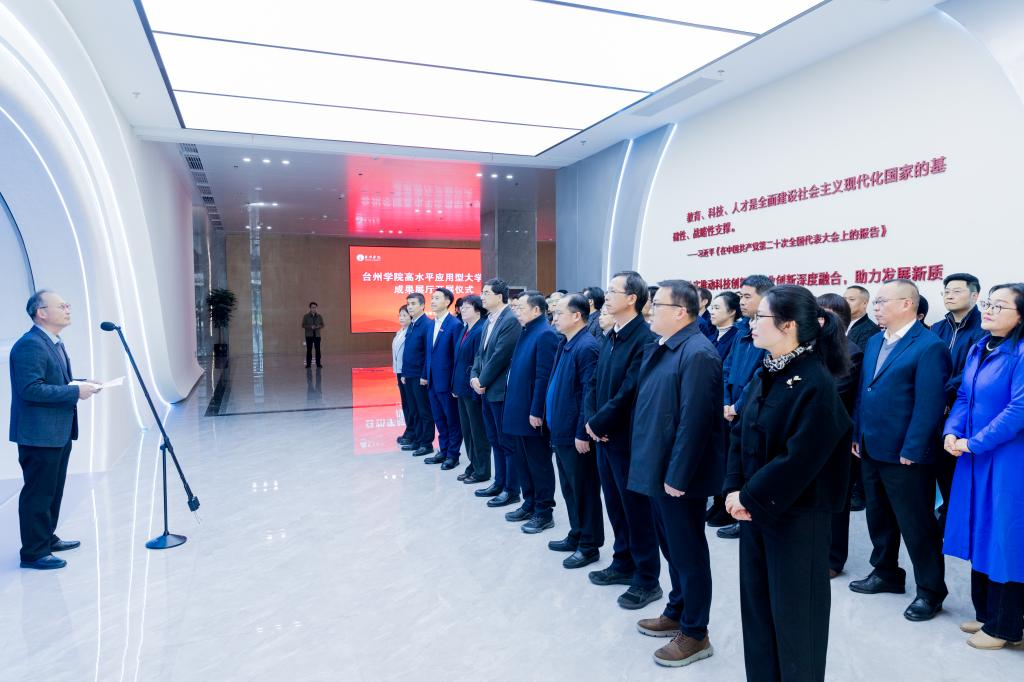
Opening Ceremony of the Exhibition Hall for the Achievements in the Construction of Taizhou University as a High-Level Applied University
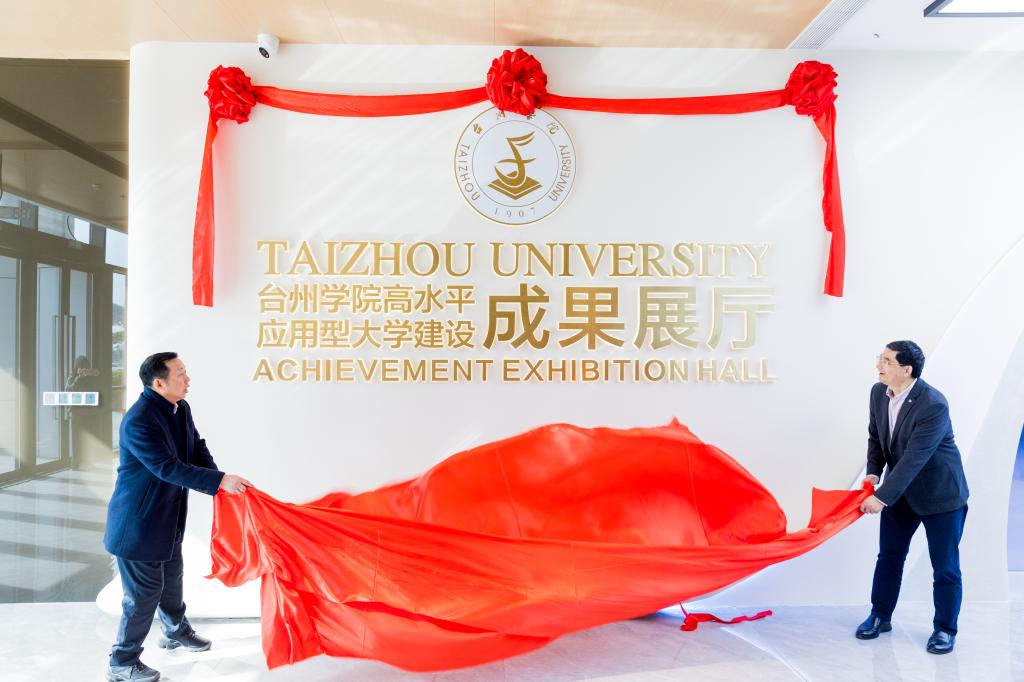
Zhu Jian and Le Chuanyong Unveil the Exhibition Hall
In his remarks, Zhu Jian welcomed the guests and expressed sincere appreciation to those who contributed to the collection of materials, design and construction, and coordination and liaison work. He noted that the exhibition hall presents a concentrated overview of the university’s leapfrog achievements in recent years. These include the “1139 Science and Technology Teams,” which comprise 106 teams serving hundreds of organizations; the alignment of seven discipline clusters and eight professional clusters with Taizhou’s “5+5+6” modern industrial system; continuous breakthroughs in teaching and research; and the creation of substantial economic and social benefits. Zhu said that every set of figures, chart, and case reflects Taizhou University’s commitment to being “rooted in Taizhou” and its responsibility to “serve and strengthen Taizhou.”
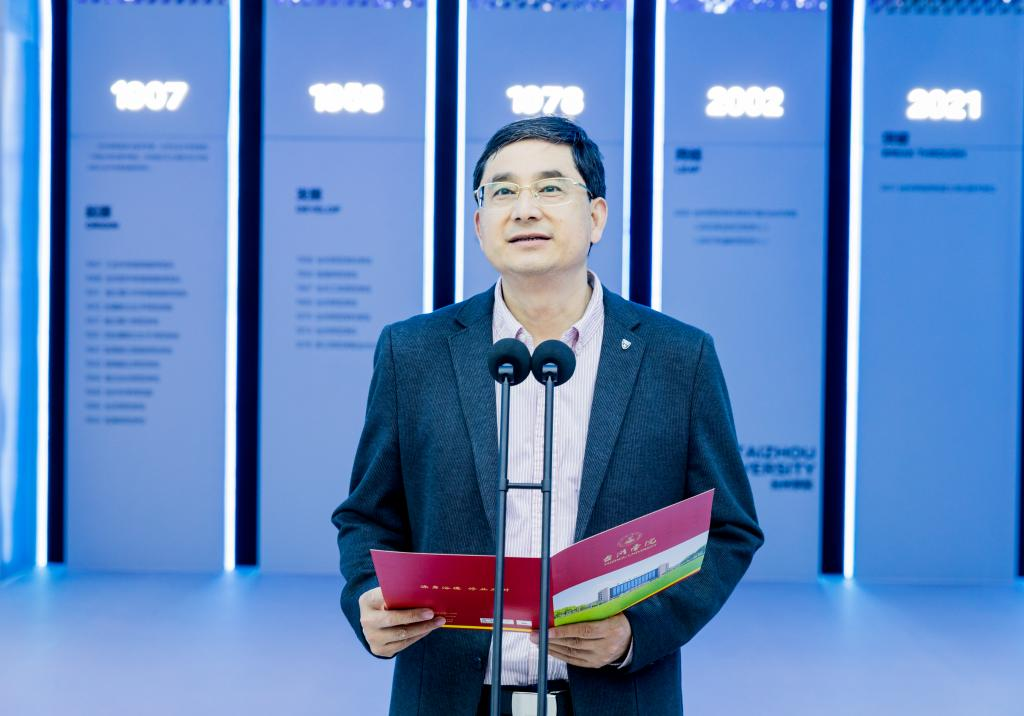
Zhu Jian delivers a speech
Zhu Jian emphasized that the exhibition hall should function as an educational platform. Through systematic and immersive displays, it should help students understand the university’s history and carry forward the motto “Nobler Morality, Greater Erudition, Quicker Adaptation, Better Application,” strengthening their sense of belonging and their aspiration to serve the country. He also said the hall should become a multidimensional “calling card” for external communication by presenting the university’s development journey, telling vivid stories of progress, and showcasing key achievements and distinctive strengths—thereby enhancing institutional confidence and public recognition.
Zhu Jian also called on the university to take the hall’s completion and opening as an opportunity to respond to new requirements for higher education in the new era. He urged continued progress in integrating education, technology, and talent, turning disciplinary strengths into innovation advantages. By focusing on local economic and social needs, the university should build disciplines and majors around industries, cultivate talent in real-world settings, and ensure research serves practical application—so that the positioning of an applied university is translated into concrete outcomes that support high-quality regional development.
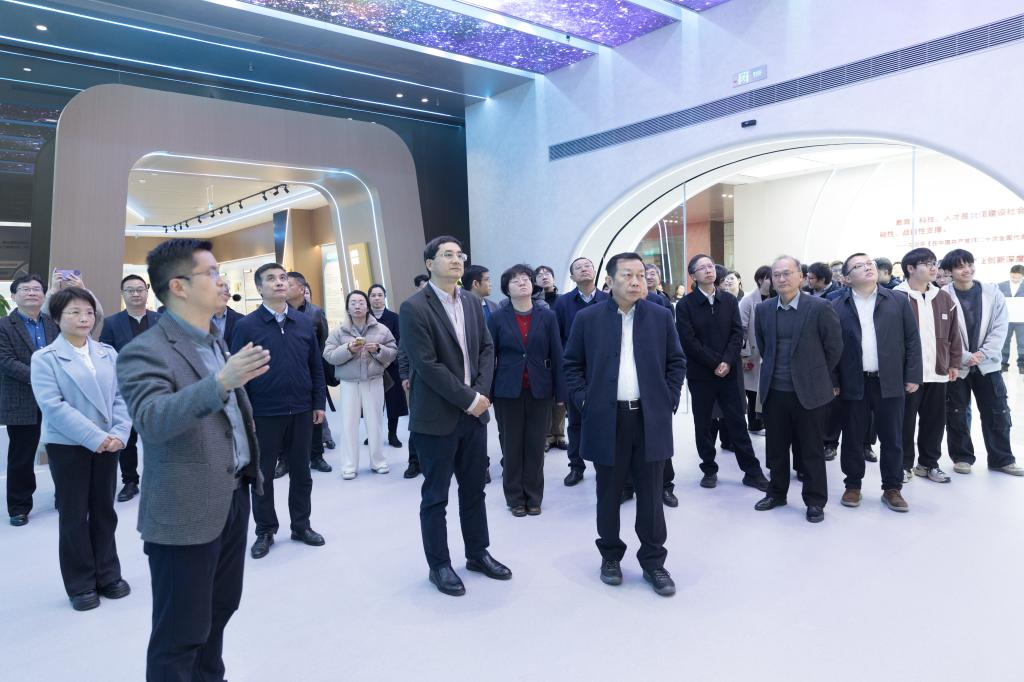
Visit the Exhibition Hall
After the ceremony, attending leaders and alumni representatives toured the exhibition hall to view the university’s achievements in building a high-level applied institution.
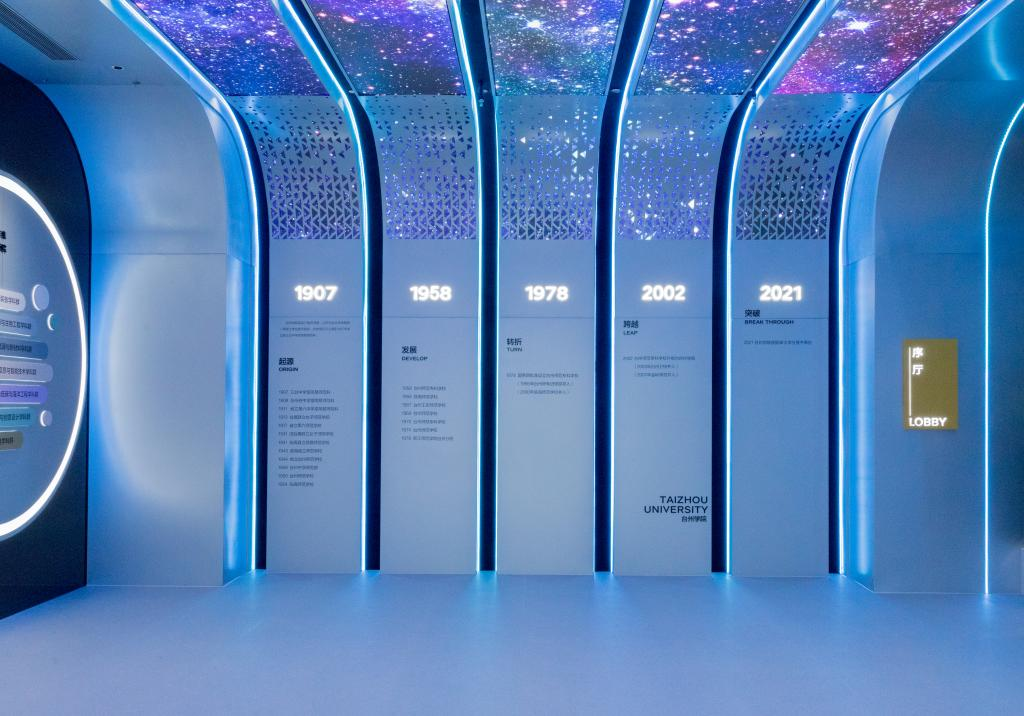
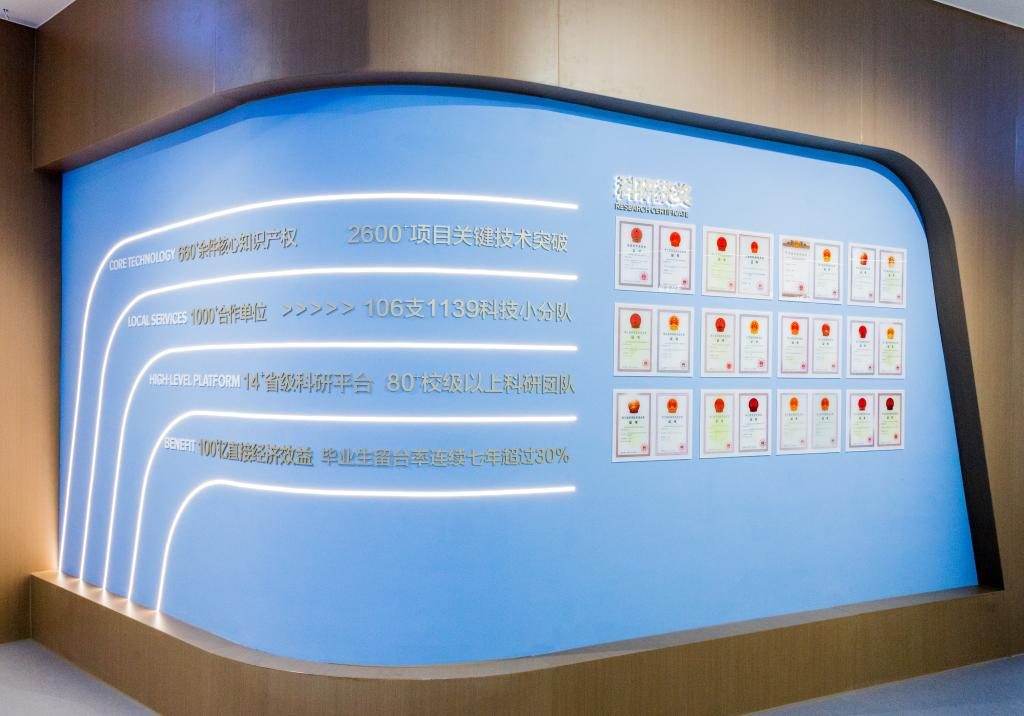
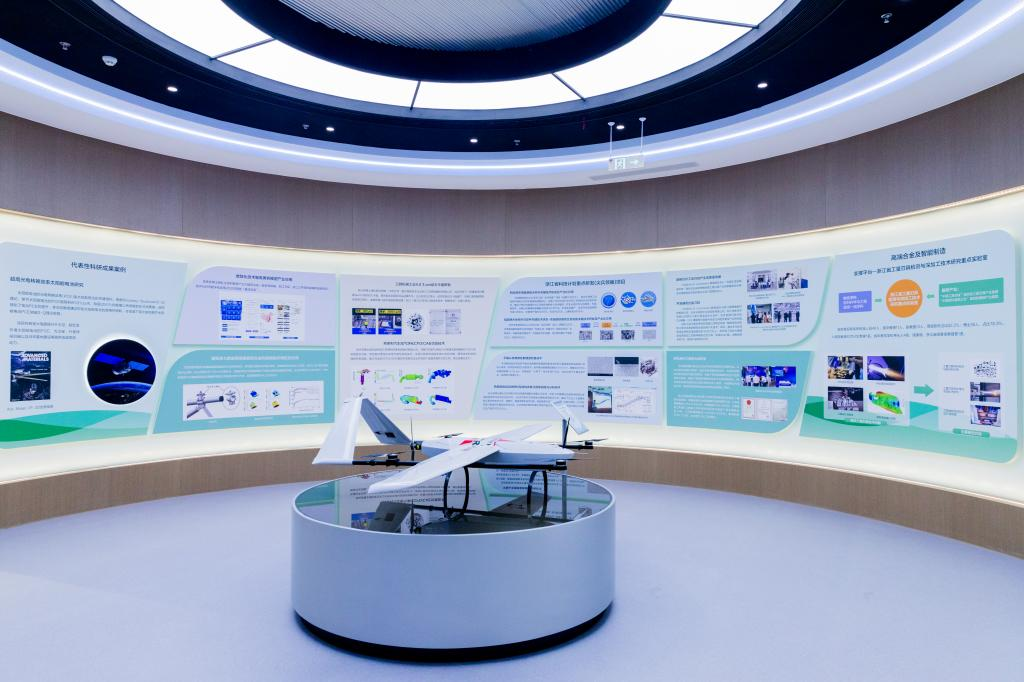

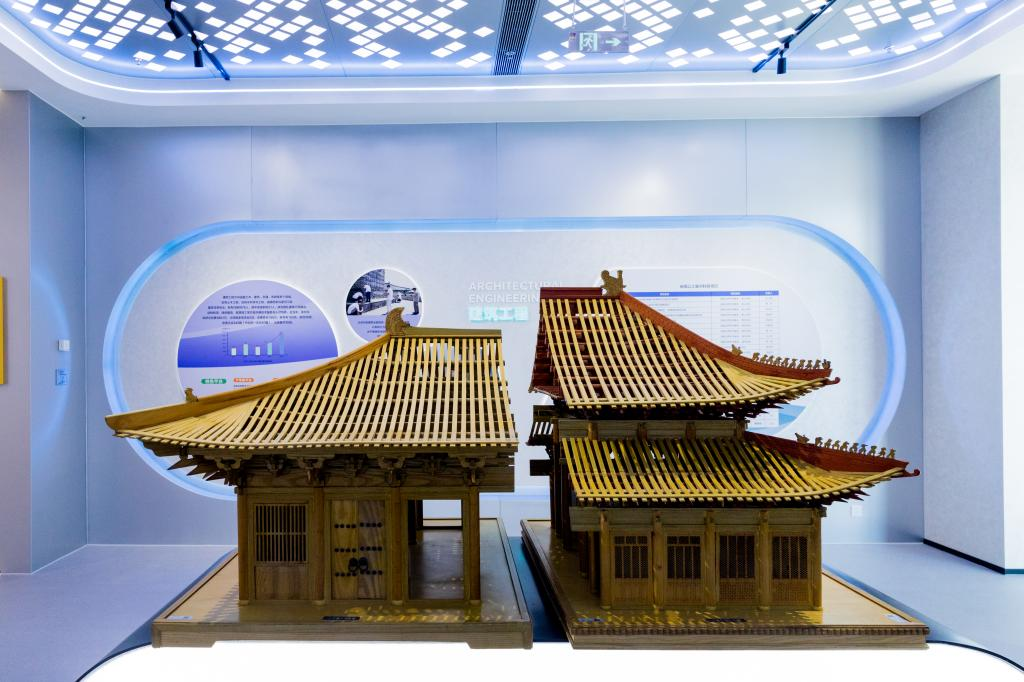

Scenes inside the exhibition hall
The exhibition hall covers more than 800 square meters. Its overall design follows a “general–specific–general” structure, drawing inspiration from Taizhou’s distinctive landscape of mountains and sea and Hehe Culture associated with Tiantai Mountain. Traditional Chinese aesthetic concepts—such as the integration of roundness and squareness and the balance between strength and softness—are incorporated into the spatial and graphic design, with a color scheme that matches the exhibition content.
In terms of content organization, the hall breaks disciplinary boundaries by integrating the university’s academic clusters and service areas into eight themed sections: Pharmaceutical and Chemical Engineering, High-End Manufacturing, New Materials and New Energy, Life and Health, Ecological and Environmental Protection, Construction Engineering, Artificial Intelligence, and Humanities and Social Sciences. The layout consists of a Prologue Hall, an Overview Hall, Thematic Halls, and an Epilogue Hall. Each thematic hall is organized as “overview + directional modules,” with modules highlighting key research directions or service fields and integrating platforms, cases, achievements, and talent cultivation into a clear and coherent exhibition framework.
Overall, the exhibition hall systematically presents the university’s recent achievements in fulfilling its mission of “running a university well to prosper a city,” promoting university–city co-development, advancing integrated reform in education, technology, and talent, and accelerating the construction of a high-level applied university.