Taizhou University held the 8th High-Level Applied University Construction Forum on December 16 at the International Conference Hall on the Jiaojiang Campus. The forum invited Professor Shi Guodong, a specialist in higher education management and engineering education, to deliver a keynote report titled “Building the Ideal New Taizhou University with the New Ideals of Taizhou University People—A Historical Review of Taizhou University’s Development.” Le Chuanyong, President of the University and Deputy Secretary of the Party Committee, and Li Junmin, Vice President and Member of the Party Committee, attended the event. The forum was chaired by Li Jianjun, Vice President and Member of the Party Committee. Mid-level leaders, deans, and teaching supervisors took part in the forum.
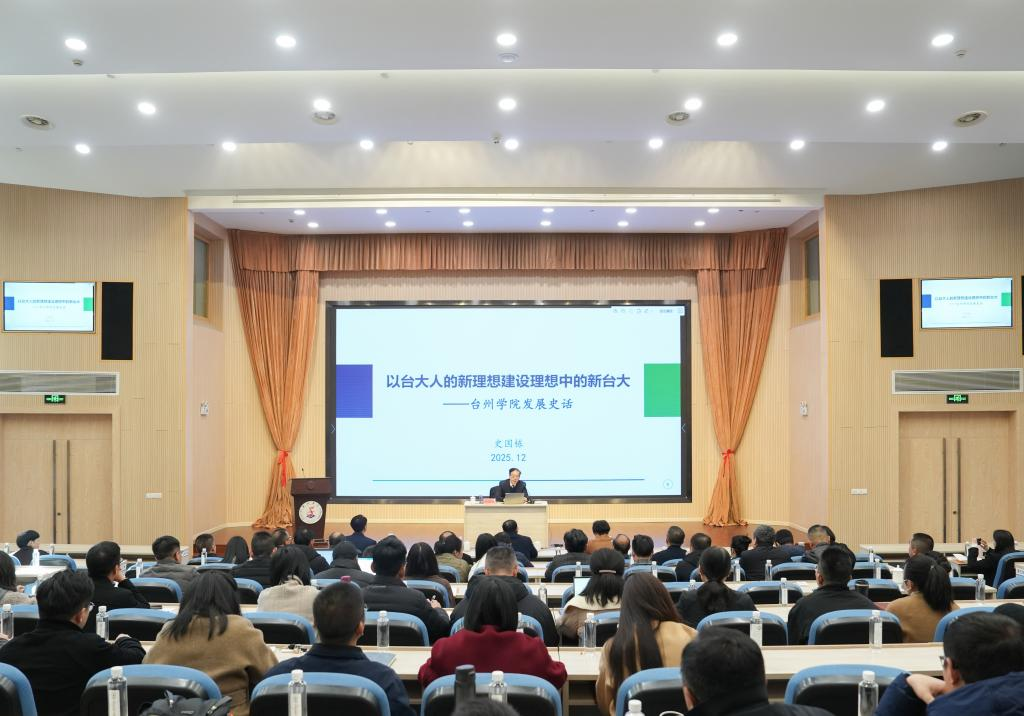
The 8th High-Level Applied University Construction Forum
Focusing on the theme of “The Ideal New Taizhou University,” Professor Shi systematically discussed the university’s development from four perspectives—historical logic, contemporary positioning, practical foundations, and prospects—drawing on his extensive experience in university evaluation and governance. He noted that Taizhou University’s growth has long been closely linked with the development of Taizhou City. Rooted in the region’s strong private economy and guided by the principle of university–city symbiosis, the university has formed distinctive strengths in applied education. Facing new trends such as the classified development of higher education and industrial transformation driven by new quality productive forces, he said the university should remain committed to the applied pathway and accelerate the shift from “discipline logic” to “industry logic.”
Professor Shi also analyzed the university’s current stage of development, emphasizing that it is moving from expansion in scale to improvement in quality, and from quantitative accumulation to qualitative change. He called for a clear recognition of pressing challenges, including homogenized competition, limited resources, and insufficient systemic capacity. On this basis, he proposed four key pathways toward building a first-class applied university: (1) reshaping the operational system to strengthen alignment between disciplines and industrial demand; (2) building an open, integrated resource ecosystem to enhance university–city symbiotic capacity; (3) establishing a competency-oriented faculty development and evaluation system; and (4) optimizing organizational structures and the quality assurance system by delegating authority and stimulating institutional vitality.
His report addressed core issues in applied university development and offered both strategic vision and actionable guidance. Several ideas he highlighted—such as “letting those who hear the gunfire command the battle,” “the depth of transformation lies in the curriculum, the difficulty lies in the classroom, and the pain lies in the teachers,” and “writing theses on the land of Taizhou”—sparked strong resonance and reflection among participants.
In his closing remarks, Li Jianjun said that Professor Shi’s report combined theoretical depth with practical relevance. He noted that it provided an accurate assessment of the university’s current situation and offered feasible recommendations for future progress, serving as an important reference for the university’s next steps. He called on all departments to organize further study and discussion, translate the report’s ideas and approaches into concrete measures, and build consensus while deepening reform. He urged all sections of the university to work together to accelerate the construction of a high-level applied university and advance key goals such as institutional upgrading and doctoral program development.
The forum was an important part of the university’s ongoing efforts to strengthen shared understanding, clarify direction, and plan for development in building a high-level applied university. TU will take this opportunity to further deepen education and teaching reform, strengthen university–city integration, and continue contributing to the development of the new “Taizhou University.”