Zhejiang Daily published on December 23, 2025 a special report titled “Deepening Industry–Education Integration, Promoting Science–Education Convergence: Taizhou University Focuses on Building a Distinctive High-Level Applied University.” The report reviews TU’s progress in recent years and summarizes its achievements in four areas: strengthening foundations through strategic planning to build a new ecosystem for university–city symbiotic development; building new “engines” by using innovation to create platforms for technological services; stimulating vitality through institutional reform to deepen a new model of talent cultivation and sharing; and raising the banner of comprehensive leadership to build momentum for high-quality development.
The report highlights the university’s firm commitment to serving Taizhou and its ongoing efforts to build a “community of shared destiny, interests, and endeavor” between the university and the city.
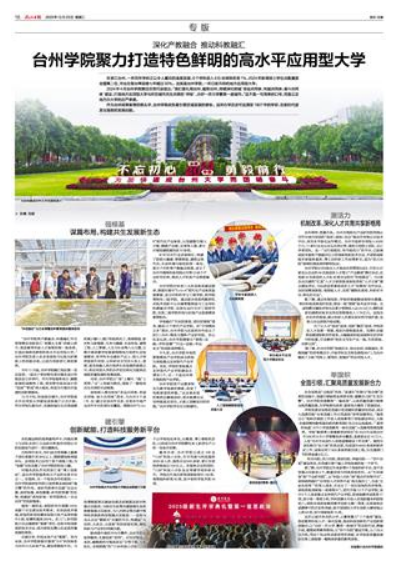
Zhejiang Daily Special Edition
The text of the special report from Zhejiang Daily is read as below:
In Taizhou, Zhejiang Province, a century-old institution is advancing at an impressive pace. Six of its disciplines rank in the top 1% worldwide in the ESI. In 2024, it ranked second nationwide for the number of newly approved master’s degree programs. The proportion of graduates choosing to work in Taizhou has exceeded 30% for seven consecutive years. This is TU, a fast-growing local applied university.
At TU’s Fourth Party Congress in April 2024, the university set a clear direction: “We must take root in Taizhou and serve Taizhou, continue to deepen the building of a ‘community of shared destiny, interests, and endeavor’ between the university and the city, create a ‘model’ of symbiotic prosperity between a local applied university and its host city, and promote urban prosperity through university development.” This is more than a slogan; it is a firm commitment to building a university grounded in its locality.
As Taizhou’s leading higher education institution, TU carries the mission of driving regional development. Founded in 1907, it has gathered strong momentum for growth in the new era.
Strengthening Foundations: Strategic Planning to Build a New Symbiotic Development Ecosystem
“TU takes industry–education integration and science–education convergence as the main approach to implementing the two major innovation initiatives of ‘Innovation Zhejiang.’ It advances integrated reforms in the education, science and technology, and talent systems, aiming to build a high-level applied university with distinctive regional characteristics.” This experience, shared by the university’s leadership at a provincial training program for university Party secretaries and presidents, has been recognized as a representative case under the Innovation Zhejiang initiative.
At the end of November this year, TU held a promotion meeting on the conceptual design of the Youth Innovation Valley project in the first conference room on its Jiaojiang Campus. Designed as a strategic project to serve the local economy and empower industrial development, the project’s two planned sections—an “Innovation Park” and an “Intelligence Park”—are expected to become a new source of innovation that supports Taizhou’s future growth.
In mid-December, an exhibition hall showcasing the achievements of Taizhou University’s high-level applied university development officially opened in the Comprehensive Science and Technology Building. Serving as a window into the university’s integration with Taizhou and its strategy of university–city symbiosis, the hall features eight thematic areas: pharmaceuticals and chemical engineering, high-end manufacturing, new materials and new energy, life and health, ecological and environmental protection, construction engineering, artificial intelligence, and humanities and social sciences. Together, these themes demonstrate how the university aligns discipline and program development with local industrial needs, places talent cultivation “on the shop floor,” and encourages researchers to “write papers on the ground.” By embedding itself more deeply into local economic and social development, the university is turning the mission of an applied institution into tangible outcomes that serve high-quality regional growth.
Today, TU is pursuing a development path characterized by “broad expansion in scope, sustained integration through key linkages, and targeted breakthroughs at critical points,” steadily drawing a vivid picture of shared prosperity between the university and the city.
The university has actively advanced the concept of a “community of shared destiny, shared interests, and shared endeavor” with the local government. It has established comprehensive cooperation with all nine counties (county-level cities and districts) of Taizhou, achieving full coverage of industrial cooperation platforms and projects across the city. Centered on Taizhou’s “5+5+6” modern industrial system, the university has used Party-building initiatives to connect the talent chain, empower the industrial chain, and strengthen the education chain, organizing more than 70 joint Party-building activities.
In response to the structure of Taizhou’s industrial clusters, the university has established industry–education integration alliances in areas such as pharmaceuticals and healthcare, intelligent manufacturing, modern construction, integrated ecological environment and green governance, and polymer materials. It has also established more than 10 industrial research institutes to promote the deep integration of talent, technology, and industry.
To align with provincial plans for three major sci-tech innovation hubs and to meet the needs of Taizhou’s “5+5+6” modern industrial system, TU has established specialized secondary colleges such as the School of Materials Science and Engineering and the School of Pharmacy. It has also co-founded the Intelligent Manufacturing and Industrial Machine Tool Science–Education Integration College with the Provincial High-End CNC Machine Tool Technology Innovation Center, and has advanced substantive operation of the Taizhou Engineers College—ensuring that its academic structure closely matches regional industrial development.
The university promotes the idea that “workshops are classrooms and projects are courses,” and has established 12 modern industrial colleges. In Huangyan—known as the “Hometown of Molds in China”—TU partnered with the district government to establish the Zhejiang (Taizhou) Mold and Plastic Industry Research Institute. In the mountainous county of Xianju, it has explored new training models such as “courses + practice + discipline competitions” and “industry + practice + graduation thesis.”
Recently, the Intelligent Mold Industry College established by TU was approved as a provincial key-supported modern industrial college. The university now has two provincial key-supported modern industrial college initiatives, the other being the Taizhou Bay Biomedical Industry College.
TU has turned real industrial needs into authentic teaching scenarios, reshaping traditional classroom learning. “In the past, textbook cases felt far away. Now, by working on real projects under the guidance of industry mentors, I truly understand the value of knowledge,” said Wang Tianxiang, a TU student.
Building the Engine: Innovation Empowerment to Create New Platforms for Technological Services
In the steady hum of machinery, Dr. He Haijie and his team conducted a crucial test in the laboratory of Zhejiang Fangyuan New Materials Co., Ltd. After two years of research, they increased the chloride ion immobilization rate in concrete to more than 96%, and raised the corrosion inhibition efficiency for steel reinforcement to over 90%. The technology has been applied in multiple coastal engineering projects, contributing to China’s “dual carbon” goals with TU’s scientific strength.
Zhejiang Provincial “Doctoral Innovation Station,” where He’s team is based, is one of many platforms through which Taizhou University supports local industries. In Wenling, another example of university–local collaboration—Taizhou University Wenling Research Institute—has become a key “engine” for county-level innovation. The institute pioneered a mechanism in which “enterprises raise questions, government provides support, universities solve problems, and the institute delivers solutions,” forming an innovation chain from “university R&D” to “institute transformation” and finally “enterprise application.”
Notably, all graduate research topics at the institute are drawn directly from real technical needs of enterprises. In coating technology, a newly developed wear-resistant coating has increased the service life of cutting tools fivefold and improved wear resistance by 300%. In Sanmen, the institute has helped enterprises win provincial “Leading Goose” projects, supported applications for national high-tech enterprise recognition, and become a model for universities assisting high-quality development in mountainous counties.
Looking forward, TU is aligning with Zhejiang’s “315” sci-tech innovation system and Taizhou’s six future industries to build high-level platforms. It has co-established key laboratories for green-island new energy and new materials with Shangbo Energy, for coastal ecosystem restoration with Tihan Ecology, and for central nervous system new drug creation with Jiuzhou Pharmaceutical. Built in close partnership with leading enterprises, these platforms are forming a new research mechanism featuring “large-scale collaboration, major breakthroughs, and significant outcomes,” ensuring that research stays closely connected to industrial frontiers.
Beyond these platforms, the university has extended its innovation services to the “front lines” of industry. In Taizhou’s manufacturing sector, one of the most recognized brands is the “1139 Technology Team,” known for being “self-sufficient, stationed long-term, and fully supportive.” Named after the university’s address and led by professors and doctoral researchers, the teams have become a signature model for nurturing new quality productive forces in the region.
To date, TU has established 106 “1139” technology teams, providing more than 3,000 person-times of technology services each year on average, serving more than 500 enterprises, and generating nearly 10 billion yuan in cumulative economic benefits. While supporting industry, these teams have also strengthened the university’s research capacity. In recent years, the university has secured 146 national-level projects and won 40 provincial and ministerial-level research awards, including 16 provincial science and technology awards.
Stimulating Vitality: Mechanism Reforms to Deepen a New Pattern of Talent Cultivation and Sharing
Along the shores of Taizhou Bay, Taizhou Biomedical and Chemical Industry Research Institute Co., Ltd. has become a standout example of institutional innovation. As the province’s first mixed-ownership public technology platform operating under a “government + university + private enterprise” model, it runs with a fully market-oriented mechanism. Taizhou municipal government provided a dedicated investment of 50 million yuan, while 11 leading enterprises contributed jointly, and the platform flexibly attracted teams led by academicians and Changjiang Scholars. With an “administration-light, market-energized” approach, it has grown into a national high-tech enterprise, with a cumulative technical service output value exceeding 10 billion yuan. It has also been recognized as a national expert service base and a postdoctoral research workstation, becoming a vivid symbol of the institutional reforms associated with the “Dynamic Taizhou Academy.”
TU has issued the “Management Measures for the Flow and Sharing of University–Enterprise Talents.” Under this framework, it has appointed 46 high-level experts from 37 leading enterprises as “industry professors,” and selected 32 high-level experts to serve as “technology vice presidents” in 30 enterprises. “Red and Blue” Talent Home, co-established with six enterprises, has been approved as one of the first provincial key construction units under the “Talent Home” initiative for universities. The university has also signed a “dual landing” agreement with Xianju County to enable joint appointments for national and provincial-level talent—realizing a coordinated model of “employment in universities, research on platforms, and transformation in enterprises.”
Through further mechanism innovation, the university has continued to address challenges in technology transfer. It has organized auctions for scientific and technological achievements, helping a number of “hidden” technologies enter the market. A key halogen-free flame-retardant technology has generated cumulative sales revenue of 2.43 billion yuan, while Jingke High-Tech’s mechanical sealing technology has achieved 179 million yuan in sales revenue. These results have not only demonstrated the market value of research outcomes but also strengthened enterprises’ momentum for upgrading.
To promote talent “mobility” and activate innovation, the university treats talent as its primary resource and is pushing forward internal reforms. It has improved the evaluation system for social service-oriented professional titles, increased the weight given to technology transfer and transformation in promotion reviews, and guided faculty to “write papers on the front lines of industry, in workshops, and across fields.”
Under its talent cultivation model of “university–city symbiosis, university–enterprise collaboration, dual-core strengthening, and integration of learning and practice,” TU has developed 89 interdisciplinary featured courses, producing large numbers of applied talents who are “practical, willing to stay, and able to grow” in Taizhou.
Raising the Banner: Comprehensive Leadership to Gather New Synergies for High-Quality Development
In advancing its “point-line-surface” layout, “express channel” mechanisms, and a series of combined reform measures, Party-building leadership has served as the “red engine” running through the process and uniting all forces. The Party Committee of TU focuses on “integration and dual excellence,” using high-quality Party building to drive high-quality institutional development and to provide strong guarantees for deepening reform and serving local needs.
The university has advanced initiatives for Party-building demonstration and quality improvement, and was selected as a cultivation unit for the fourth batch of “Provincial Party Building Demonstration Universities.” The “Reclaiming and Establishing the Heart” Organizer Navigation Studio was included in the first group of construction units recognized by the Provincial Department of Education. The Dachen Island Reclamation Spirit Education Base was named a Red Culture Promotion Base by the Ministry of Education. The integrated ideological and political education practice program spanning universities, secondary schools, and primary schools—titled “The Taste of Truth”—was selected as a typical case by the Ministry of Education. In 2023, the university’s “Professor and Doctoral Anti-Drug Education Lecturer Group” delivered anti-drug education lectures across 335 schools in Taizhou, reaching nearly 100,000 people directly; the initiative was selected as one of the “Ten Practical Matters for the Ideological and Moral Development of Minors in Taizhou.” A Party branch known affectionately as “Brother Fali” among students and staff assessed more than 8,000 bridges nationwide, with results applied to reinforcement projects for over 500 bridges, saving transportation authorities more than 400 million yuan.
Guided by Party building, the university has integrated the development concepts of “Harmonious Taizhou University, Vibrant Taizhou University, Beautiful Taizhou University, and Happy Taizhou University” (the “Four Taizhou Universities”) into every aspect of its work.
According reports, TU has recently added nine provincial-level research platforms, including three provincial key laboratories, ranking among the leading institutions of its type in Zhejiang. From “workshop classrooms” to “industrial research institutes,” and from “science and technology task forces” to “mixed-ownership platforms,” the university has consistently upheld the belief that cultivating applied talent is not “assembly-line processing,” but “ecological nurturing.” Its achievements are substantial. The university has been approved for nine national first-class undergraduate courses, upgraded 12 industrial colleges (two of which were selected as provincial key-supported modern industrial colleges), and won 17 provincial teaching achievement awards, including three first prizes. Its results in student academic competitions rank among the top eight of newly established undergraduate institutions nationwide. It also won a second prize in the National College Teacher Teaching Innovation Competition, marking a historic breakthrough. In the China International College Students Innovation Competition, it earned 58 awards at or above the provincial level, including 15 national awards.
Named after its city, TU is now focusing on Zhejiang’s goals of building “three strong provinces,” promoting integrated development of education, science and technology, and talent, and driving deep integration of technological innovation with industrial innovation. Through concrete actions that aim to “run a good university and prosper a city,” it is accelerating transformation and upgrading, and helping reshape the region’s higher-education landscape. Using the “Four Taizhou Universities” initiatives as its brush and the land of Taizhou as its canvas, the university continues to pursue landmark achievements and paint a vibrant picture of high-quality development.