The PRC Ministry of Education’s Information Platform for the Supervision of Chinese-Foreign Cooperation in Running Schools announced on December 31, 2025 the latest list of approved Sino-foreign cooperative education institutions. Taizhou University San Bernardino Institute of Technology, jointly established by Taizhou University and California State University, San Bernardino (CSUSB), has been officially approved (License No.: MOE33USA02DNR20252569N). The approval marks a major step forward in the university’s international exchange and cooperation and signals a new phase in the development of internationalized education at TU.
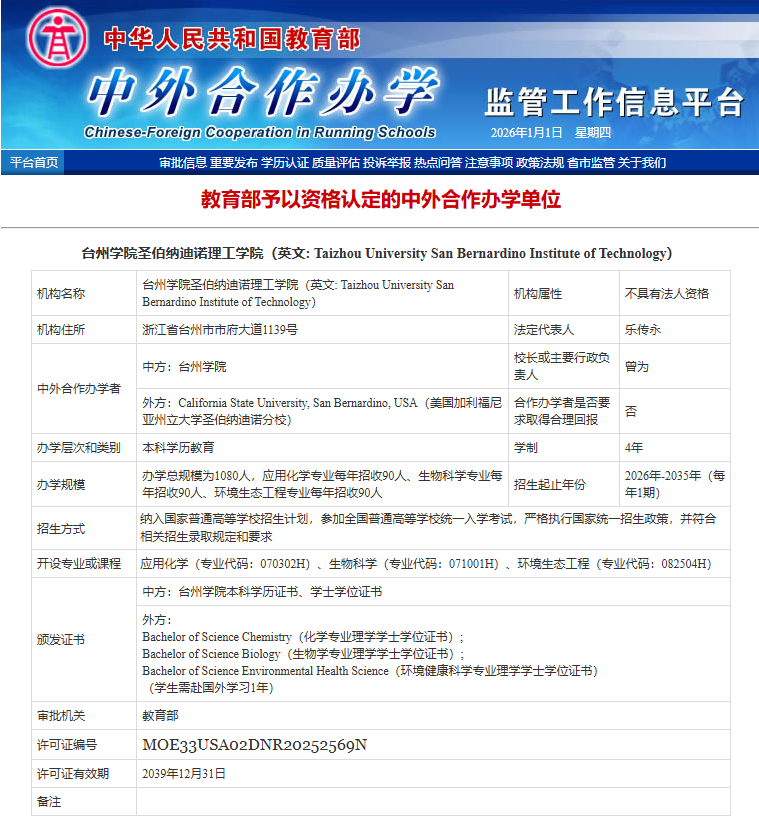
Ministry of Education Sino-Foreign Cooperative Education Regulatory Information Platform
Taizhou University San Bernardino Institute of Technology is a non-independent legal entity Sino-foreign cooperative education institution of our university. It offers three undergraduate programs: Applied Chemistry, Biological Sciences, and Environmental Ecological Engineering. The program follows a 4-year academic system and adopts a “3+1” dual-campus, dual-degree model. Students study at our university for the first three years and go to the United States for the fourth year. Upon meeting the corresponding requirements, they will be awarded bachelor’s degrees from both the Chinese and American institutions. The Institute’s enrollment is included in the national regular higher education enrollment plan and follows the unified national enrollment policies. The total enrollment capacity is 1,080 students, with plans to commence admissions in 2026.
Taizhou University San Bernardino Institute of Technology is a non-independent legal entity Sino-foreign cooperative education institution under TU. It will offer three undergraduate programs—Applied Chemistry, Biological Sciences, and Environmental Ecological Engineering—under a four-year academic system. The institute will adopt a “3+1” dual-campus, dual-degree model: students will study at TU for the first three years and complete the fourth year in the United States. Students who meet the academic requirements will be awarded bachelor’s degrees from both TU and CSUSB. Enrollment will be included in China’s national regular higher education admissions plan and will follow unified national admissions policies. The total planned enrollment capacity is 1,080 students, with admissions expected to begin in 2026.
The institute’s establishment aligns closely with Zhejiang Province’s “315” sci-tech innovation system, particularly the goal of building a highland for life and health science and technology. With a focus on biopharmaceutical development and ecological civilization, the institute aims to introduce high-quality international educational resources, deepen China-U.S. exchanges in culture and technology, and strengthen the university’s discipline and program development. It will also cultivate internationally competent, high-quality applied talents with a global perspective, strong commitment to national development, and innovative practical abilities—providing stronger support for regional economic and social development.
TU has long served national and regional development strategies by steadily expanding educational opening-up. The university has established partnerships with more than 50 universities in over 10 countries and has previously cooperated with New Mexico State University (USA) to run a Sino-foreign cooperative undergraduate program in civil engineering. The newly approved institute represents a milestone in the university’s internationalization, marking the transition from operating individual cooperative programs to establishing a full-fledged cooperative institution. This development is expected to deliver progress in program level, enrollment scale, and localized internationalization, while enhancing the university’s international visibility and competitiveness. It will also add new momentum to the opening-up of regional higher education and promote deeper international integration in talent training, discipline development, and faculty growth—helping build a more open and resilient landscape for educational cooperation.
Founded in 1965, California State University, San Bernardino comprises five colleges and offers more than 70 majors. The university enrolls approximately 18,500 students and has 1,777 faculty members, 76% of whom hold doctoral degrees. CSUSB is known for its academic strength and strong social reputation. From 2004 to 2015, The Princeton Review recognized it as one of the “Best Colleges in the West” for 11 consecutive years, placing it among the top 25% of universities nationwide; only seven of the 23 campuses in the California State University system have received this distinction. In 2015, Forbes included CSUSB in its “America’s Best Colleges” list for the sixth time, and its undergraduate education was ranked among the nation’s “Top 20% Best Undergraduate Education” for three consecutive years.
CSUSB is accredited by the Western Association of Schools and Colleges. It ranks second in safety among California public universities and is listed at No. 171 in the 2025 U.S. News National Rankings, No. 92 among public universities, No. 48 in “Best Value Colleges,” and No. 3 nationwide in “Top Performers on Social Mobility.” More than 90% of graduates gain employment or enter graduate school within six months of graduation. The university maintains partnerships with more than 270 higher education institutions in 46 countries and provides more than 75 undergraduate and graduate programs for over 900 international students from more than 50 countries. Its College of Natural Sciences—one of the university’s key colleges—includes nine departments, such as Biology, Chemistry and Biochemistry, Health Sciences, and Human Ecology. With research funding exceeding USD 120 million, the college has produced many outstanding alumni in chemistry, biology, and environmental and ecological engineering.

Entrance of California State University, San Bernardino

Campus of California State University, San Bernardino

California State University, San Bernardino Library

Official mascot Cody (left) and coyote sculpture (right) at California State University, San Bernardino