Recently, the 8th Zhejiang Provincial College Student Rural Revitalization Innovation Competition, themed “CCB Yunongtong Cup”, came to a conclusion at Zhijiang College of Zhejiang University of Technology. Co-guided by the Department of Education of Zhejiang Province, the Department of Agriculture and Rural Affairs of Zhejiang Province, the Zhejiang Rural Revitalization Bureau and the Department of Culture and Tourism of Zhejiang Province, the competition was hosted by the Zhejiang Provincial College Student Science and Technology Competition Committee. The participating teams of our university stood out and won 5 gold awards, 2 silver awards and 9 bronze awards at the provincial level amid fierce competition involving 5,325 teams and 41,464 participants from 108 universities across the province.
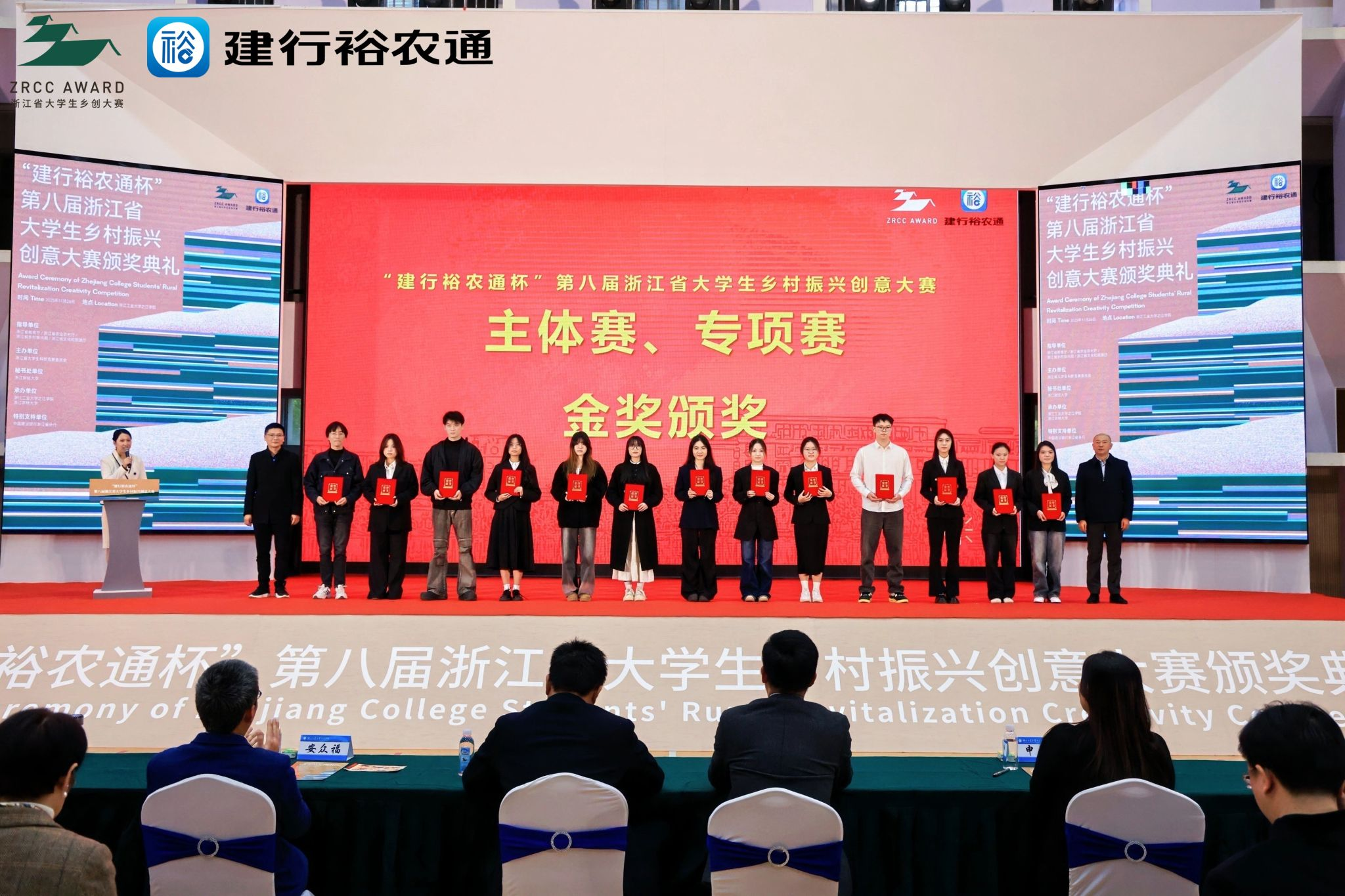
Award Presentation Scene
Launched on May 27, 2025, this competition aims to enhance college students’ innovative and practical capabilities, accelerate the cultivation of design and innovation talents, and promote the concept of “Innovation Empowers Rural Revitalization”. The competition consists of two categories: the main competition and special competitions. The first one is divided into two types of questions: tender villages and optional villages, covering four tracks — rural industry innovation, rural planning and design, rural humanistic public welfare, and future agricultural technology — which fully meet the diverse needs of rural revitalization.
Since the launch of the university-level competition, with the strong support of the Entrepreneurship College, the undertaking unit — the College of Architecture and Civil Engineering — has aligned with the requirements of the provincial competition and steadily promoted various preparation work. A total of 65 teams were formed from 10 secondary colleges of the university. After strict review by external experts, 35 teams successfully advanced to the provincial semi-finals. For the projects shortlisted for the finals, the college innovatively adopted a training model combining “in-depth professional guidance + roadshow practical polishing”, specially inviting senior experts in the province to carry out multiple rounds of special guidance to help the participating projects iterate, upgrade and improve quality and efficiency. In the end, through the joint efforts of teachers and students, several teams won honors:
· Team from the College of Architecture and Civil Engineering: “Lotus by the Henghe River, Gray Stones Build the South of the Yangtze River” and “Dong’an Flower Habitat · Chongfu Construction Environment — Landscape Improvement Design of Rural Complex”
· Team Guizhou Ren from the College of Humanities: “Returning Boat Reflects Dreams — Cultural IP Creative Operation and Planning of Anqiaotou Village”
· Team Yunying Jiutai from the College of Humanities: “Cloud Steps Pave the Painting Scene, Ancient Rhymes Reflect Jiutai — Tourism Route and Industrial Development Planning of Jiutai Gou Village, Kuocang Town” — all won the gold award in the main competition;
· Team Chongjiudui from the College of Art: “Integrity Walks the Right Path · Clear Breeze Spreads the City — IP Image Design and Cultural and Creative Development of 'Yicheng Ancient Road'“ won the gold award in the “Youth Integrity Tide” Cultural and Creative Special Competition at the provincial level.
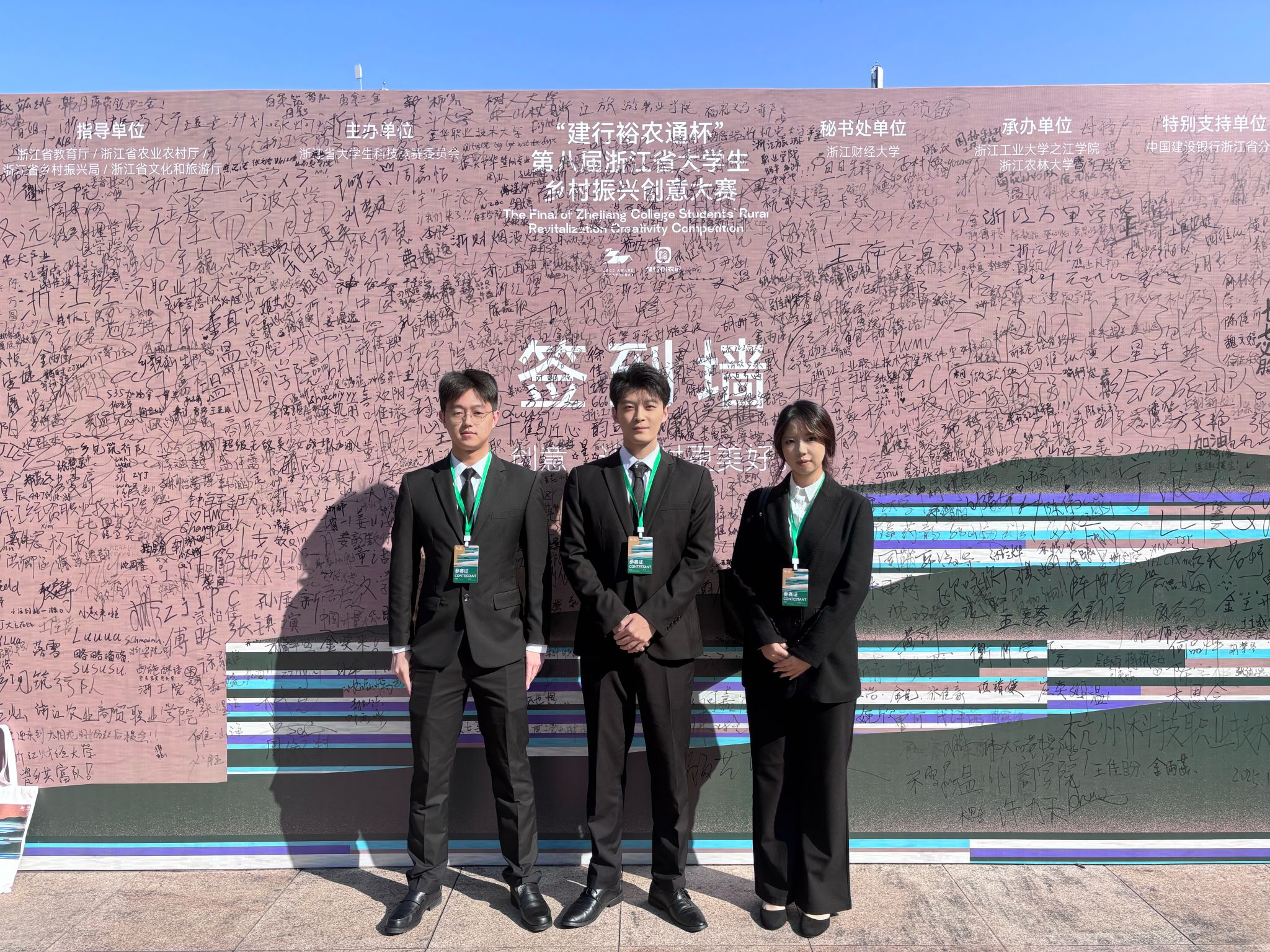
Project “Lotus by the Henghe River, Gray Stones Build the South of the Yangtze River” Wins Gold Award
As a Class A competition in Zhejiang Province, it is the highest-standard, largest-scale and most influential university-specific competition serving rural revitalization in the province. It took the lead in exploring the “real questions solved quickly” and “four-in-one (government, enterprise, university and village)” model to help rural revitalization in China. Adhering to the orientation of solving practical problems in rural revitalization, the competition innovatively built a competition mechanism of “villages put forward questions, universities provide answers, and promote implementation”. It not only provides new ideas for practicing the spirit of “two advances and two returns” of the Provincial Party Committee and the Provincial Government and solving core problems such as rural industrial prosperity, but also accumulates experiences for universities to empower rural revitalization and help poverty alleviation, becoming an important practical platform for universities to serve local development.