A delegation from the Asian Simulation Federation (ASIASIM), led by its Secretary-General Weng Jingnong, visited the Jiaojiang campus on the afternoon of 29 July. Accompanied by Zhang Wen, Head of the Economic and News Division of the Zhejiang Provincial Foreign Affairs Office, the delegation attended a symposium focused on integrating industry, academia, and research in simulation technologies to support advanced manufacturing and the digital economy in Taizhou. The meeting was attended by Li Jianjun, Vice President of Taizhou University and Member of the CPC Taizhou University Committee, chaired by Wang Bei, Deputy Director of the Taizhou Foreign Affairs Office, and joined by representatives from local municipal bureaus and academic departments.
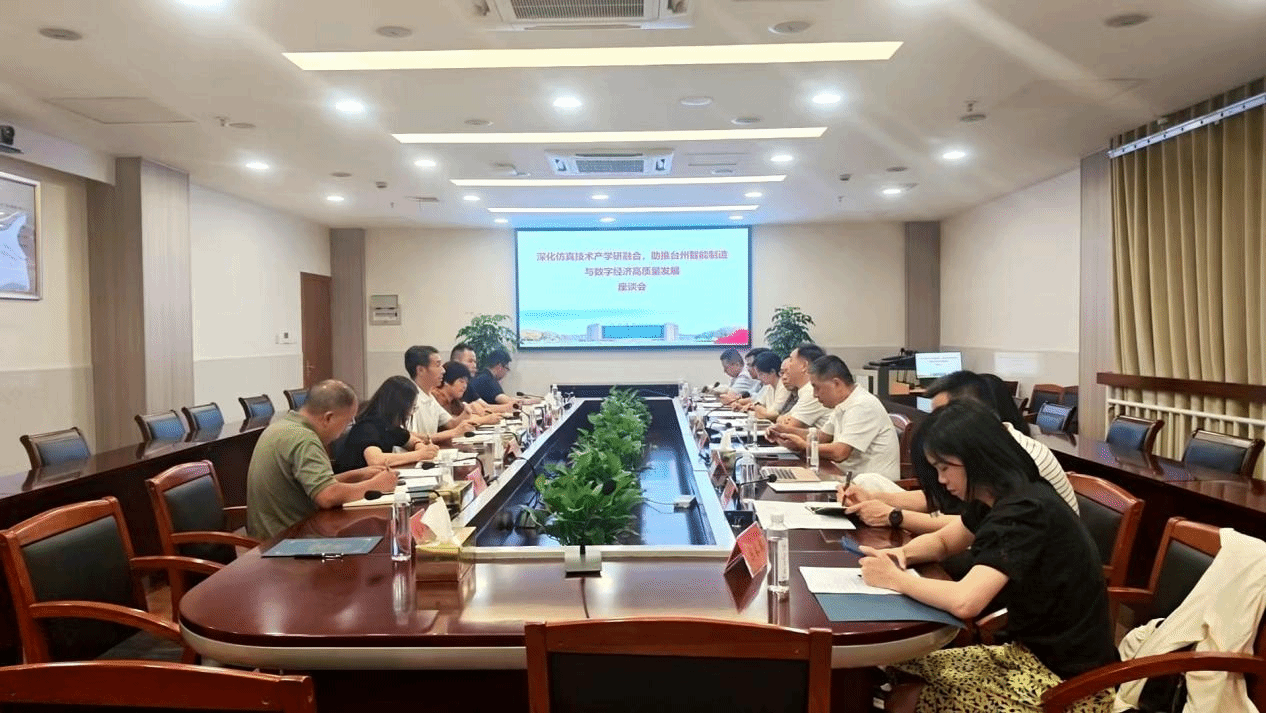
Symposium in session
Professor Li Jianjun outlined the university’s recent progress in academic development, scientific innovation, and collaborative industry research. He noted that the institution is building an “AI + Manufacturing” academic ecosystem with seven prominent discipline clusters, prioritizing applied and interdisciplinary fields with a focus on embodied AI and smart manufacturing. Following the establishment of the Taizhou Key Industry Research Institute for Artificial Intelligence in 2025, the university has achieved critical breakthroughs in automated visual inspection, predictive maintenance, and flexible manufacturing, offering high-level platform support for the convergence of AI and simulation. To date, it has undertaken nearly 20 collaborative simulation projects, ranging from escalator chain auxiliary wheels and digital twins for water injection systems to robotic motion modeling. Furthermore, the university has established provincial-level platforms, including a practical training centre integrating industry with education for intelligent manufacturing and an industrial innovation and service complex for smart sewing equipment, both equipped with dedicated virtual simulation laboratories and advanced hardware and software systems.
Chen Wei, Head of the Digital Economy Division at the Taizhou Municipal Bureau of Economy and Information Technology, delivered an overview of the region’s intelligent manufacturing, digital twin, and industrial simulation sectors. Two local industrial clusters—the Eastern Zhejiang Machine Tool Cluster and the Jinhua-Taizhou Hilly and Mountainous Agricultural Machinery Cluster—have been named national-level advanced manufacturing clusters. As a designated national pilot city for new industrial technological upgrades, Taizhou leads the province in the number of “future factories” and exemplary industrial brains, and is currently driving artificial intelligence adoption across 1,000 local firms, where simulation design is playing an increasingly vital role in digital transformation.
Yang Zheng, an executive committee member of the Taizhou Municipal Bureau of Culture, Radio, Television, Tourism and Sports, delivered a report on the development of Taizhou’s cultural tourism sector and the progress of its bid to become a UNESCO Creative City of Gastronomy. Under its flagship campaign “Chasing the Sunshine to Taizhou”, the city’s tourism draws upon prominent cultural and scenic assets—including Wenling, celebrated as the first place in mainland China to greet the millennium sunrise, the 5A-rated historic Guoqing Temple, and its heritage as the cradle of Hehe (harmony and unity) culture. Complementing these is a robust culinary heritage, anchored academically by TU’s undergraduate degree in culinary arts—the first of its kind in Zhejiang province. Since the city formally initiated the UNESCO bid in 2023, delegations have joined the China Cuisine Association for high-level international exchanges in Geneva. Work is advancing steadily as Taizhou seeks to leverage global platforms to raise its profile.
Weng Jingnong introduced the governance and network of ASIASIM. Approved by the State Council and registered as an international scientific organization in China, the federation was originally initiated by simulation societies across China, Japan, South Korea, Singapore, and Malaysia. It now connects more than 70 member institutions across nearly 20 countries, bringing together over 2,000 specialists and 10,000 industry partners. The federation is committed to advancing global innovation and resource integration in simulation technology, fostering international exchange and in-depth cross-border collaboration, and promoting the integration of industry, academia, research, and application. It also works to establish international standards and certification, secure an authoritative voice in top-tier global simulation journals, strengthen talent development and public science outreach, and tackle critical industrial simulation bottlenecks. Looking ahead, it is set to play a pivotal role in leading the governance, technological innovation, industrial transformation, and ecosystem building of simulation sciences in the age of artificial intelligence.
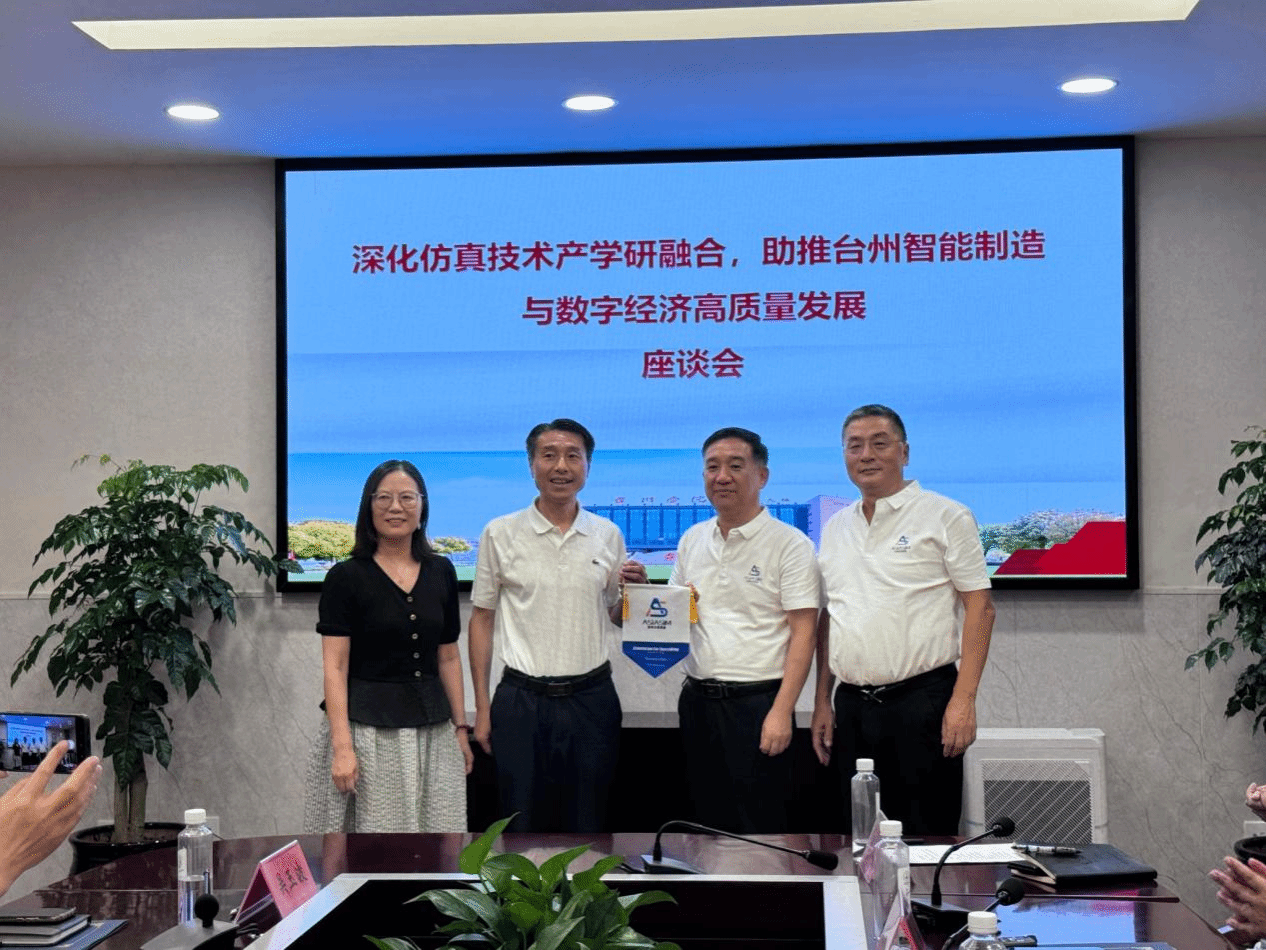
Presentation of the ASIASIM banner
Delegates engaged in practical discussions on intelligent manufacturing, digital twins, and digital tourism. The talks led to a consensus on establishing a tripartite cooperation mechanism, clarifying mutual requirements, and drafting a memorandum of understanding to channel international simulation resources directly into local technological and economic development.
The delegation toured several research and development facilities on campus, including the exhibition hall for the development outcomes of TU as an applied university, the UAV facility, and the Zhejiang Engineering Research Centre for High-Performance Industrial Pumps and Vacuum Equipment. Mr. Weng praised the university’s technical infrastructure and practical output, noting that Taizhou’s diverse industrial ecosystem presents substantial scope for future partnership.