An unconventional final project presentation and assessment was held right on the production floor of Zhejiang LEO Pump Co., Ltd., a subsidiary of LEO Group, on the afternoon of October 29. Pu Jiaqi, a student enrolled in the Mechanical and Electrical Engineering program in 2023, and his team, jointly trained by Taizhou University (TU)’s School of Engineering and LEO Group, presented their project on a vision-based device for monitoring remaining enameled wire. The project is the first among TU’s 2026 Student Science and Technology Innovation Projects under the Industry–Education Integration Initiative to hold its completion defense at a company and successfully put the device to use on the production line.
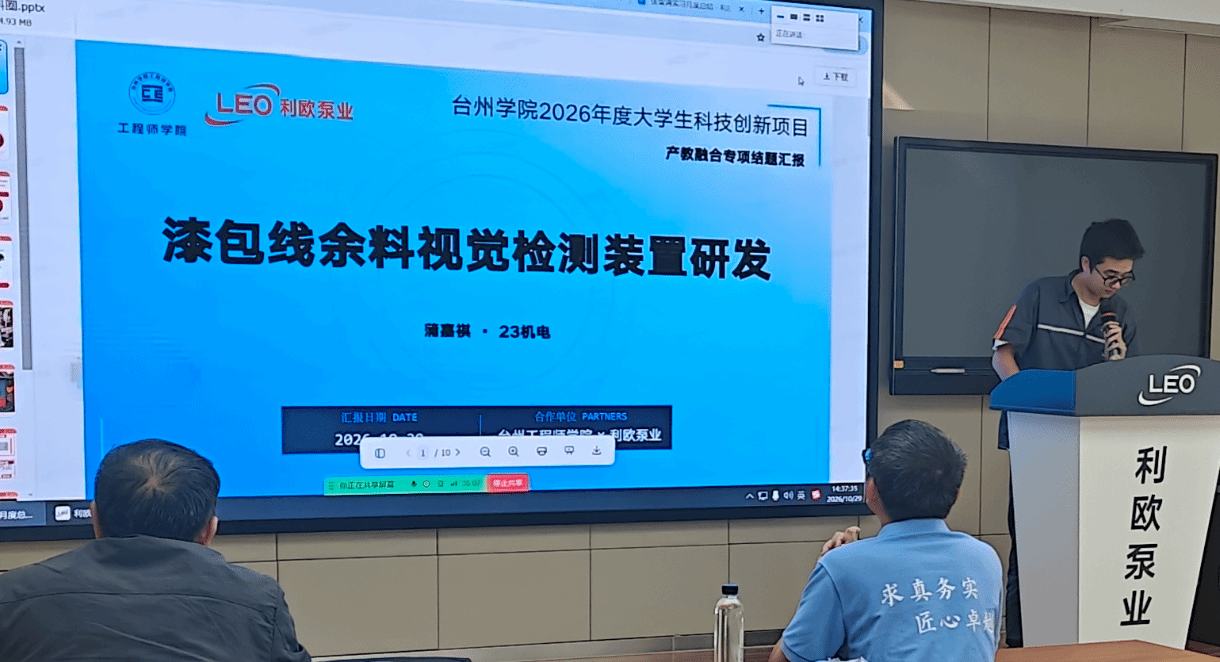
A student presenting the project at the completion defense at the Company
The company issues a challenge: bringing real production-line problems to the university
During the production of water pump motor windings, the supply of enameled wire coils has long relied on workers visually monitoring the coils. This often puts workers in a dilemma. If they start monitoring too early, one worker must spend 10 to 20 minutes keeping a close watch on each coil, making it highly time-consuming for him or her to oversee multiple machines. If they start monitoring too late, the machine may continue running idle once the wire runs out, increasing the time required for each material changeover from the usual one minute to as long as six minutes and significantly reducing production efficiency. Faced with the risk of missed inspections during night shifts and the resulting production delays, LEO Group brought this production-line challenge to the School of Engineering, hoping to draw on the innovative capabilities of university faculty and students to find a low-cost, highly reliable solution.
Students rise to the challenge: tackling a complex problem from scratch with a low-cost solution
After taking on the project, Pu Jiaqi and his team worked under the guidance of Professor Xia Ruting and Dr. Qin Liming from the School of Engineering, as well as corporate mentors Kong Tingjie and senior engineer Ying Junbo. They went deep into the workshop frontline, went through four rounds of design iteration, and ultimately delivered an impressive solution.
The team independently developed a detection system based on an ESP32-S3 microcontroller and a camera module. It adopted an innovative dual-link communication architecture using ESP-NOW and UDP to ensure that the power supply could still be cut off within milliseconds even in the presence of channel interference. By optimizing the algorithm, the team reduced the detection cycle to 250 milliseconds, achieving an extremely rapid response: from detecting a shortage of wire to shutting down the entire machine in less than one second.
What impressed the company most was the cost efficiency. The hardware cost of each detection unit was only approximately RMB 430, an order of magnitude lower than that of the commercially available visual inspection solutions, which can cost tens of thousands of yuan. Moreover, the system’s precise control of detection thresholds ensures that the machine stops only when just a few loops of enameled wire remain on the coil, thus making full use of the material while eliminating the need for constant manual monitoring and preventing missed inspections.
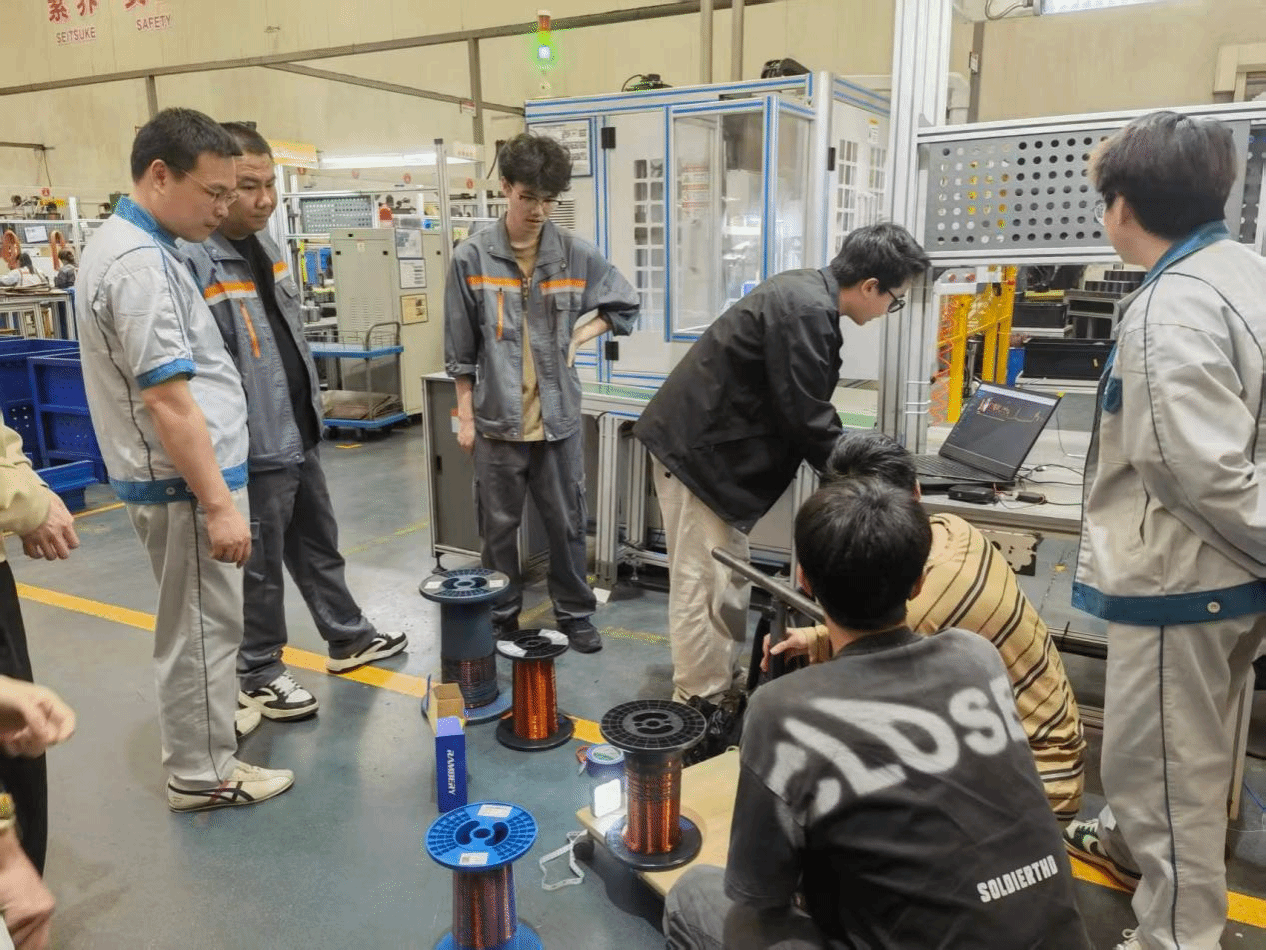
The project team demonstrating the device in operation at the company’s workshop
The production line puts the solution to the test: defense held in the workshop wins high praise from company engineers
By the time of the project completion defense, the device had been operating reliably on LEO’s production line for more than two months. Its web-based monitoring interface and one-click recovery feature had won praise from workshop staff. After listening to the team’s presentation and reviewing the operating data on site, company engineers highly praised the device. They noted that it not only addressed an actual production challenge but also had strong potential for replication, and confirmed that the company would promote its application on other similar production lines in the future.
From undetected wire shortages causing machines to run idle to automatic shutdown within a second, and from labor-intensive on-site monitoring to real-time monitoring via a web interface, the project achieved remarkable results. The on-site completion defense also provided compelling evidence of the effectiveness of the School of Engineering’s project-based talent development model through university–enterprise collaboration.
Going forward, the School of Engineering will continue to deepen its Golden Seed Program, a training initiative built around the principles of addressing real-world challenges with practical solutions and testing them on actual production lines. Through this initiative, more students will have opportunities to develop strong professional capabilities by solving real problems faced by enterprises and to grow into outstanding engineers who can contribute to the high-quality development of local manufacturing.