A special lecture titled “AI-Empowered Research Decision-Making: New Paradigms for Bibliometric Analysis and Grant Applications Based on Large Language Models” was successfully held on December 11 at the International Conference Hall of the Jiaojiang Campus. Jointly organized by the Office of Science and Technology and the Office of Humanities and Social Sciences, the event aimed to actively respond to the national innovation-driven development strategy and effectively enhance the research efficiency and innovation capacity of faculty members. The lecture was delivered by Ms. Ma Yajuan, Senior Training Instructor from Beijing KingBook Technology Company, and was attended by more than 100 faculty members.
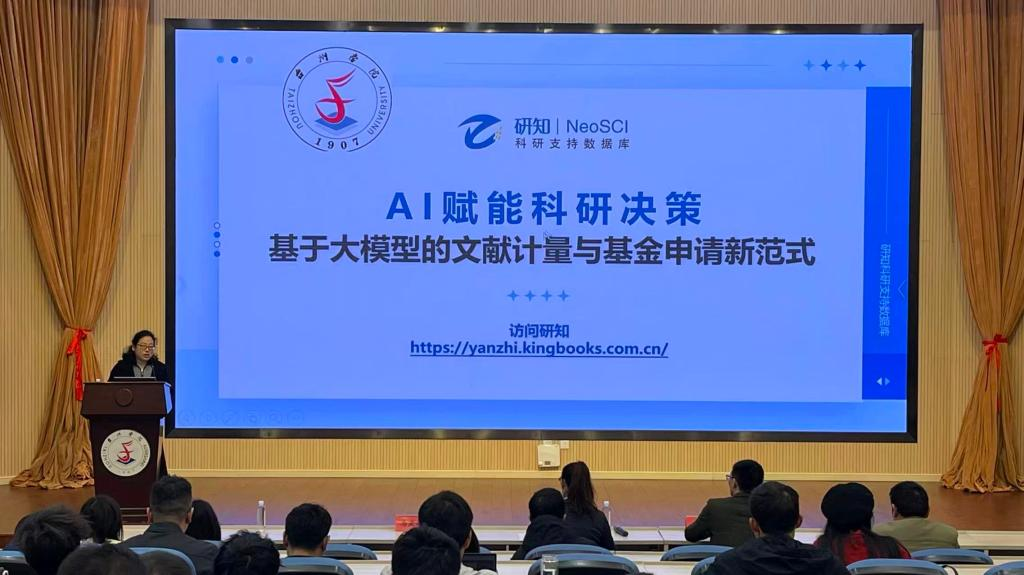
Scene from the lecture
The lecture focused on leveraging cutting-edge bibliographic data resources and large-scale artificial intelligence models to optimize the entire research workflow, with the aim of providing researchers at our university with efficient, intelligent research tools and new methodological perspectives. Ms. Ma systematically explained how a new generation of AI-powered research platforms transform massive volumes of literature data into in-depth intelligent insights, and elaborated on novel methodologies based on large language models, including literature analysis, automated generation of review articles, identification of research innovation points, and intelligent construction of grant proposals. Through these approaches, the platforms enable a full cycle from analyzing data to making decisions, ushering in a new paradigm of intelligent research decision-making.
The on-site discussion session was lively, with participating faculty members engaging in insightful exchanges on practical issues such as standards for the use of images in AI-generated research reports and the academic recognition of report outcomes. Ms. Ma provided professional and detailed responses to each of these questions.
The successful organization of this lecture represents one of the important initiatives by the university’s research administration departments to serve research activities and promote the intelligent transformation of research paradigms. The lecture not only provided a platform for learning and academic exchange for researchers, but also injected new momentum into enhancing the university’s overall capacity for scientific research and innovation. We believe that, empowered by a new generation of AI intelligent tools, researchers at our university will be better equipped to address research challenges with greater efficiency, accelerate the intelligentization of research decision-making, and contribute more substantially to advancing scientific and technological innovation at the university and supporting regional economic and social development.