A symposium on the compilation of The Comprehensive History of Taizhou (Pre-Qin to Sui–Tang Volume) was held on the afternoon of December 16, 2025 at the Communist Party Members’ Activity Center of TU’s School of Humanities in Building No. 1 of the Linhai Campus. The event was organized by the School of Humanities and conducted in a hybrid online–offline format. Renowned scholars of Taizhou’s history and culture—including Lu Ruping, Xu Sanjian, and Ma Shuming, together with directors of museums from various districts and counties across Taizhou—gathered with members of the university’s project team to offer targeted and constructive advice for the compilation of the volume.
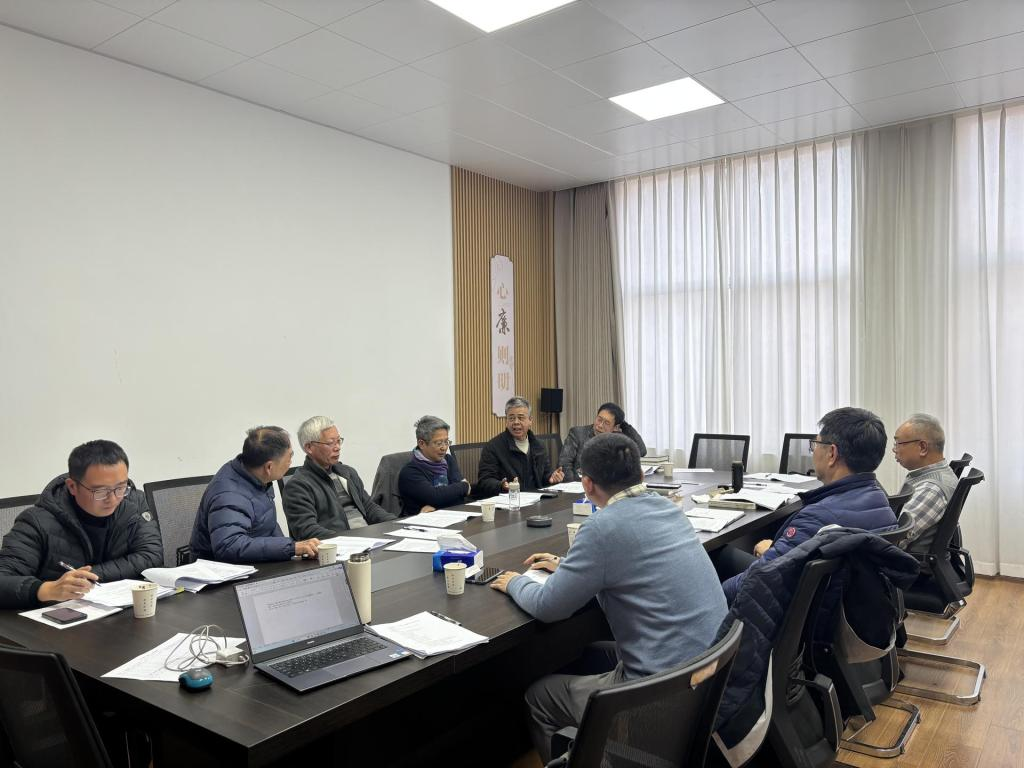
The compilation symposium
Luo Zhengming, Dean of TU’s School of Humanities, delivered the opening remarks. He emphasized that the Pre-Qin to Sui–Tang period, as a crucial formative stage in Taizhou’s historical and cultural development, represents the very source of the region’s civilization. The compilation of this specific volume, he noted, is not only an academic endeavor to consolidate research on local history, but also a cultural mission to preserve cultural roots and deepen a shared sense of local identity.
During the core discussion session, participating experts and scholars engaged in in-depth deliberations centered on six key agenda items. Drawing on his extensive expertise in local historical and cultural studies, Lu Ruping submitted a draft outline and offered detailed supplements and professional refinements. He put forward concrete suggestions on the logical coherence between chapters and the balance of content coverage, thereby helping to establish a clear writing framework for the subsequent compilation work.
Focusing on the optimization of the comprehensive history’s structural framework, Xu Sanjian proposed streamlining the sections related to the natural environment and integrating them with discussions of social development in specific historical periods, so as to enhance narrative continuity.
Ma Shuming emphasized that the compilation of a comprehensive history should strike a balance between academic rigor and textual readability, and that legendary or anecdotal historical materials should be treated with cautious verification and judicious selection.
Zhang Xun clarified the key priorities for the Neolithic chapter, suggesting that it take the Xiantang Culture at Xianju County and the Baimutang Site in Tiantai County as the focus, supported by archaeological evidence, to clearly outline the landscape of Taizhou’s prehistoric civilization.
With regard to the integrated use of textual sources and archaeological materials, Chen Yinshi, Director of Linhai Museum, stressed the need to avoid major discontinuities in historical narratives. He suggested that legendary materials be handled through clear labeling and appropriate citation, and recommended systematic reference to classical works such as Taizhou Prefectural Gazetteer, alongside authoritative findings from the Zhejiang Provincial Institute of Archaeology.
In outlining the historical trajectory, Luo Yonghua, Director of Huangyan Museum, emphasized that official dynastic histories should serve as the primary foundation of the compilation. He called for particular attention to the history of water conservancy development along the Taizhou Guanguan Canal, the evolution of the ceramics industry, and the interrelationship between the ancient Daxi kilns and canal-based transportation, thereby providing a clear direction for writing the region’s economic and social history.
Drawing on local archaeological discoveries, Guo Hui, Director of Xianju Museum, proposed integrating the elements of Buddhism and Daoism into the historical narrative of Xianju.
Lin Dayue, from the Linhai News Media Group, advocated for greater exploration and utilization of Taizhou-related materials found in epitaph inscriptions and collections of ancient literati, cautioning against allowing the comprehensive history to devolve into a mere compilation of sources.
Professor Hu Zhengwu of Taizhou University suggested conducting an in-depth examination of Taizhou’s distinctive role in the national historical landscape from the late Eastern Han to the Six Dynasties period. Professor Zhang Chengzhong, focusing on practical aspects of compilation, underscored the need to resolve challenges in historical periodization, strengthen source verification, and define the overall scope and length of the work at an early stage.
Following extensive discussions, participating experts from within and outside the university reached a consensus on standards for source compilation and the overall framework. The symposium effectively integrated historical research resources from across Taizhou, clarified the core approach to compiling the Volume, and laid a solid foundation for the efficient advancement of subsequent work.