On the afternoon of April 17, the School of Teacher Education (Physical Education) hosted two distinguished guests from East China Normal University: Professor Yang Xiaozhe from the Institute of Curriculum and Instruction, and Dr. Wang Bingru, editorial director of Global Education Outlook. Dean Zhang Fuwei chaired the session, which was attended by the school’s research faculty.
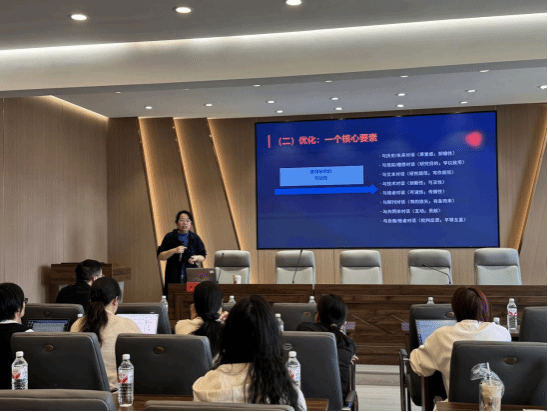
Dr. Wang Bingru delivering her report
Dr. Wang’s presentation, titled “Between Writing and Publication: Educational Academic Papers,” introduced the editorial philosophy, peer-review system, and key thematic directions of Global Education Outlook. She analyzed common pitfalls in manuscript submission and, drawing on her editorial experience, systematically outlined the critical steps from drafting to publication. She stressed that a high-quality paper must rest on a solid research question, a clear theoretical framework, and rigorous methodology, while also resonating with contemporary policy concerns and aligning with the journal’s focus. In the Q&A session, she engaged deeply with faculty on topics including research design, methodological choices, and responding to reviewer feedback.
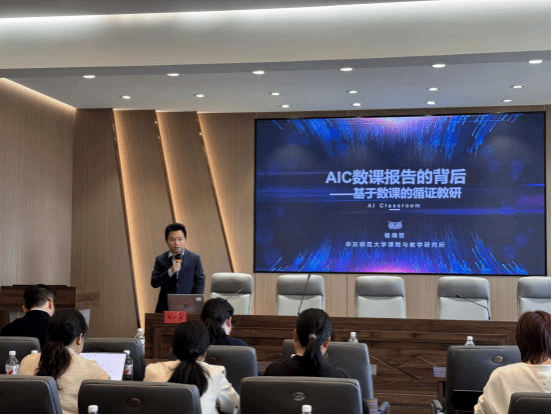
Professor Yang Xiaozhe presenting
Professor Yang Xiaozhe spoke on “Behind the AIC Digital Lesson Reports: Evidence-Based Teaching Research Based on Digital Lessons.” He explored the paradigm shift in classroom observation and teaching research enabled by intelligent technologies. Using multimodal data, classroom analysis can move beyond the limitations of traditional experience-based methods, enabling precise diagnosis of teaching behaviors and process-oriented mining of student learning. Yang illustrated with case studies how smart tools can decode teacher-student interactions and cognitive pathways, offering teachers visual empirical evidence for reflective and targeted improvement. After the talk, faculty discussed data acquisition, tool application, and practical implementation strategies.
Dean Zhang Fuwei concluded that Dr. Wang’s talk provided systematic methods and practical advice for overcoming hurdles in academic writing and publishing, while Professor Yang introduced new technology-empowered approaches to classroom research and teacher professional development. He emphasized that enhancing academic competence and transforming teaching research are key drivers of the school’s high-quality development, and encouraged faculty to strengthen their academic foundations, embrace technological change, and produce more high-level outcomes.