On April 20, Professor Sune Svanberg, member of both the Royal Swedish Academy of Sciences and the Royal Swedish Academy of Engineering and former Chair of the Nobel Physics Prize Committee, together with Professor Katarina Svanberg, visited Taizhou University at the invitation of the School of Life Sciences. The visit was part of the university’s strategic efforts toward “upgrading to a higher-level university, applying for doctoral programs, and striving to be first-class” and strengthening international academic collaboration. Vice President Han Deman chaired the academic sessions, held in Conference Room 241 of the Life Sciences Building. Dean Zhao Kai, Associate Dean Zong Enmin, Professor He Sailing from Zhejiang University, and Dr. Huang Jing from South China Normal University attended, along with faculty and student representatives.

Vice President Han Deman chairing the meeting
Vice President Han Deman extended a warm welcome to the two international experts. He noted that laser spectroscopy and biomedical photonics are cutting-edge interdisciplinary fields, and the Svanbergs’ world-renowned research offers valuable guidance for the development of biology, environmental ecology, and medical disciplines at TU. He expressed hope that this lecture series would deepen Sino-Swedish academic cooperation, broaden international perspectives, and enhance innovation capacity, thereby supporting high-level discipline development and the university’s “upgrade and doctoral program” initiative.

Professor Sune Svanberg during his lecture
Professor Sune Svanberg delivered the first lecture, titled “Multidisciplinary Laser Spectroscopy: Environment, Ecology, Agriculture and Food Safety.” Drawing on his extensive research, he systematically introduced advanced applications of laser spectroscopy in environmental monitoring, ecological surveying, agricultural technology, and food safety. He highlighted key techniques such as lidar atmospheric remote sensing, fluorescence lidar, drone-based environmental fluorescence mapping, and non-destructive food packaging inspection, underscoring the vital role of interdisciplinary research in addressing major societal challenges.
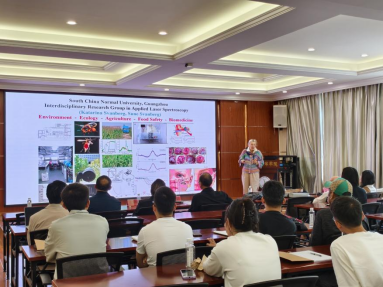
Professor Katarina Svanberg presenting
Professor Katarina Svanberg then spoke on “Some Challenges in Medicine Addressable with Biophotonic Tools.” Focusing on biomedical photonics, she presented breakthrough advances in laser spectroscopy for early precise tumor diagnosis and photodynamic targeted therapy. She detailed core technologies including laser-induced fluorescence tissue characterization, interstitial photodynamic therapy, and gas absorption spectroscopy in scattering media (GASMAS), along with their clinical applications in early cancer screening, pediatric inflammation differentiation, and preterm infant lung monitoring. These innovations offer new approaches to tackling antibiotic resistance and improving disease diagnosis and treatment.
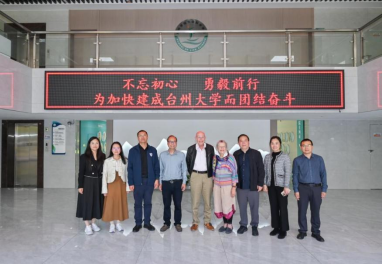
Group photo at the School of Life Sciences
Prior to the lectures, the Svanbergs visited Zhejiang Provincial Key Laboratory of Coastal Damaged Ecosystem Restoration, where they examined the lab’s work on secondary invasion prevention, typhoon-disturbance restoration, and saline-alkali land improvement. They highly appreciated the lab’s achievements in both fundamental research and applied innovation.