On the afternoon of June 30, a special academic exchange with the theme of Innovation Research on Green Materials and National Fund Application was held by the Institute of Intelligent Packaging Design, School of Art and Design, Taizhou University. Professor Cheng Wanli and Professor Han Guangping from the College of Materials Science and Engineering, Northeast Forestry University were invited to deliver special reports.
Han Deman, Vice-President of TU, attended the meeting and gave an opening address. Participants included Ke Shenhai, Dean of the School of Art and Design; Associate Professor Gao Xun from the School of Architecture and Energy Engineering, Wenzhou University of Technology; Associate Professor Li Qingde from the School of Design, Foshan University; Post-doctoral Researcher Fan Shutong from Northeast Forestry University; Associate Professor Hu Yi from the College of Textile Science and Engineering, Zhejiang Sci-Tech University; as well as heads and teachers of design majors from the School of Art and Design. The meeting was presided over by Chen Feng, Deputy Dean of the School of Art and Design.
On behalf of the university, Han Deman extended a warm welcome and sincere thanks to the two experts in his opening address. He pointed out that green materials serve as an important pillar for China’s “dual carbon” strategy and sustainable development, and enjoy broad prospects for integrated development with design disciplines. He hoped that the school would take this exchange as an opportunity to deepen cooperation with high-level domestic research teams, further refine its research directions, and improve the quality and standard of applications for national-level scientific research projects.
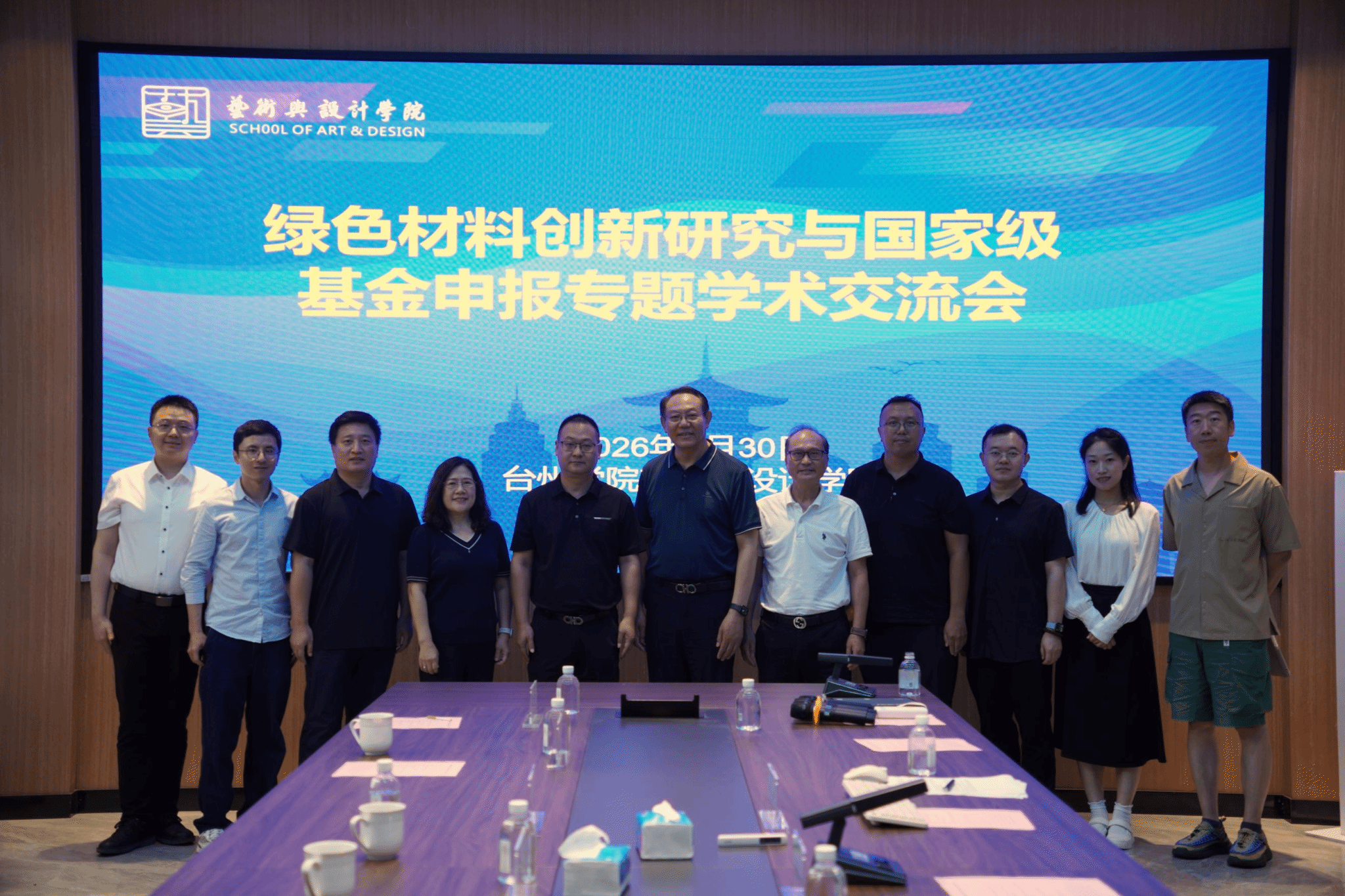
Group photo
During the special-report session, Professor Han Guangping delivered an academic report entitled Multi-scale Structural Design and Functional Application of Biomass Materials. Professor Han has long been devoted to research on multi-scale structural design, functionalization and high-value utilization of biomass materials. She has presided over more than ten projects including those supported by the National Natural Science Foundation of China, published over 160 academic papers in journals such as Nature Reviews Materials, Nature Communications and ACS Nano, and has been listed among the World’s Top 2 % Scientists for five consecutive years.
Focusing on interdisciplinary applications spanning materials, textiles and product design, her report systematically introduced the controllable fabrication and applications of hierarchical-structure micro-nano fibrous materials. The cutting-edge achievements covered full-scale structured fabrics for passive radiative cooling, all-biomass electro-spun fibrous membranes for high-efficiency air filtration, cellulose-based ambient-dried aerogels for atmospheric water harvesting, super-elastic triboelectric hydrogels for self-powered wearables, and shrink-resistant thermos-responsive moisture-absorbing cellulose hydrogels. Her report has offered new insights for interdisciplinary research on green materials within the design discipline.
Professor Cheng Wanli delivered a report on Topic Refinement, Proposal Writing and Review Logic for National Natural Science Foundation Projects. Since his embarking on research in 2002, Professor Cheng has presided over six projects supported by National Natural Science Foundation of China and had more than 20 years of review experience for national-level and provincial natural science funds. For four consecutive years, he has successfully guided five young-faculty members in his research team to secure the Youth Science Fund Projects of NSFC.
Taking the conception and drafting of multiple fund proposals by himself and his team as core practical cases, his report offered in-depth and detailed explanations covering topic refinement, proposal drafting and revision, as well as review logic from a practical perspective. It provided highly practical guidance for participating teachers applying for national-level scientific-research projects.
During the interactive session, participating teachers had discussed with two experts on the interdisciplinary integration of materials and design disciplines, refinement of research topics for fund applications, and frequently asked questions in proposal writing.
In his concluding remarks, Ke expressed gratitude to two experts for their excellent presentations. He noted that two reports, with both cutting-edge academic vision and abundant practical experience, were of great guiding significance for the school to promote the interdisciplinary integration between design and materials science, as well as improve teachers’ research capacity and their performance in national-level project applications. Taking this academic exchange as a new starting point, the school will further strengthen interdisciplinary collaboration and synergistic innovation, and strive to achieve new breakthroughs in applications for national-level scientific research projects.
The successful academic exchange has built a platform for teachers to conduct face-to-face communications with high�level domestic experts, further broadening their academic horizons, clarifying research orientations, and fostering a stronger research atmosphere.