Professor Hai Bin of Hainan University, a member of the standing council of the Society for Ancient Chinese Literature and a featured speaker on CCTV’s Lecture Room, delivered an academic lecture titled “When Li Bai Meets AI” at Taizhou University on September 18, at the invitation of the School of Humanities. The lecture was chaired by Professor Luo Zhengming, dean of the School of Humanities, and was attended by faculty members and students from the school.
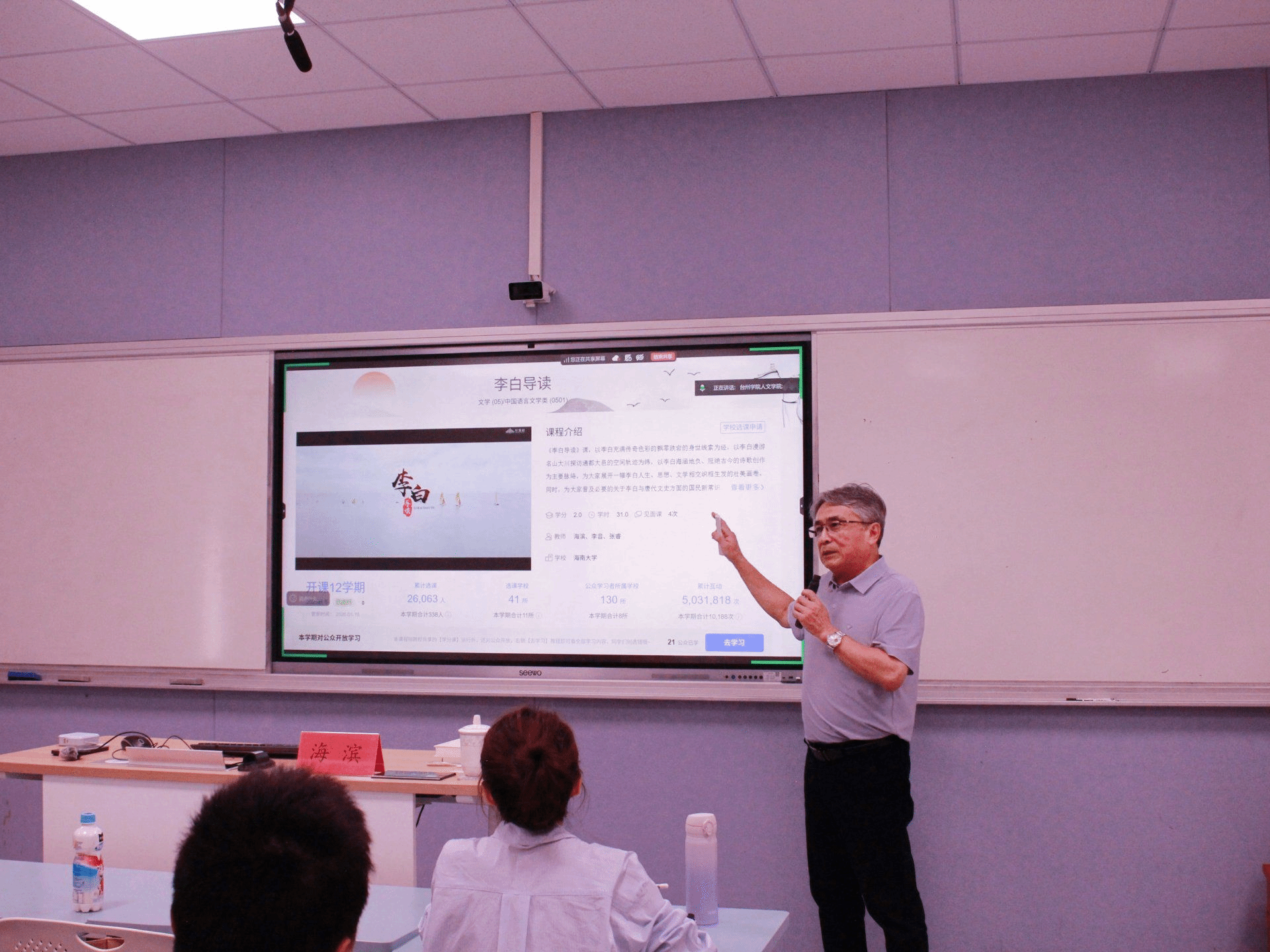
Professor Hai Bin delivering the lecture
Opening the lecture, Hai Bin spoke about what he described as a “pilgrimage and verification” journey to Tiantai and Linhai, following in the footsteps of Li Bai, Luo Binwang and other writers. Turning to youthful talent and the study of Chinese, he argued that studying Chinese should broaden one’s mind and cultivate one’s character.
Setting aside the familiar topic of “using AI to imitate classical poetry,” the lecture centered on the idea of “being with things without being bound by things,” exploring how artificial intelligence can empower the teaching of classical literature while remaining alert to the risk of being carried away by technology.
Hai Bin then took the ongoing development of “An Introduction to Li Bai” — an undergraduate course recognized at the national level as a first-class course — as an example, showing in concrete terms how AI can empower teaching, from framework design and resource integration to assessment and evaluation.
He contrasted a traditional online course with an AI-integrated course now under development: the older version relied mainly on linear video lectures, so students could only passively follow a preset path; the new version introduces a knowledge graph and an AI teaching assistant, restructuring the original four thematic modules into a 12-chapter structure organized around shifts in time and geography.
The restructured course covers the Western Regions, Bashu, Jingchu, Wuyue, Chang’an and other areas, and breaks the content down into knowledge-graph nodes, each corresponding to a single knowledge point or concept. Each node is equipped with authoritative texts, video material and AI extension resources. This multidimensional integration of resources presents each concept in multiple formats, offering a reference model for how a liberal arts classroom can preserve its scholarly character while staying attuned to how students actually take in information.
At the lecture, Hai Bin demonstrated how the AI teaching assistant can retrieve resources across chapters on “the relationship between Li Bai and Yuan Danqiu” and generate a dedicated knowledge graph and path for further exploration.
Hai Bin pointed out that technology has not replaced the lecturer; rather, it addresses the individual learning needs that a traditional classroom finds hard to respond to one by one, giving individualized instruction a new form through technological support and offering attending teachers an idea they can transplant into their own practice.
He cautioned that AI can generate inaccurate or fabricated information, and that it can serve only as a source of ideas; its output should never be copied directly. He stressed that technological innovation must not amount to “old wine in a new bottle”: the core of upgrading a course lies in renewing its academic content.
During the discussion session, faculty and students raised questions on the use of AI in Chinese language teaching in primary and secondary schools, the value of integrating classical literature with AI, and the practical difficulties of putting AI to work in the classroom. Hai Bin noted that AI tools can be used in both online and face-to-face teaching, and that artificial intelligence should be positioned as an auxiliary tool for the humanities.
In his concluding remarks, Professor Luo Zhengming observed that digital and intelligent technologies are reshaping the way the humanities are taught and learned, and that the lecture offered important insights for the school’s digital humanities and knowledge graph initiatives.
Participating faculty members said they would carry what they had learned about knowledge graph construction, AI teaching assistants and process-based assessment into their subsequent teaching practice and curriculum development, continuing to explore effective ways for technology to empower the classroom.