Professor Ma Yongmin’s team from the School of Pharmaceutical Sciences/Advanced Research Institute of Taizhou University recently published a research paper titled “Catalytic photoinduced deoxygenation via B(C₆F₅)₃-enabled oxygen atom transfer for aromatic C-H amination of alkylarenes” in Nature Communications. Associate Professor/Dr. Pan Zhentao from the School of Pharmaceutical and Chemical Engineering is the first author, with Ma Yongmin and Pan Zhentao serving as co-corresponding authors. TU is the first affiliation of the paper.
The team has achieved a significant breakthrough in photoinduced deoxygenation by reporting, for the first time, a catalytic photoinduced deoxygenative C(sp²)–N coupling reaction. They developed a novel strategy based on B(C₆F₅)₃-catalyzed oxygen-atom transfer, enabling the catalytic deoxygenation of N-hydroxyphthalimide. This process efficiently generates nitrogen-centered radicals and allows the selective C(sp²)–H amination of alkylarenes.
Notably, the method overturns the conventional pathway in which N-hydroxyphthalimide typically undergoes dehydrogenation to form oxygen-centered radicals, often leading to benzylic oxidation. It also avoids the need for stoichiometric additives. With water as the sole byproduct, the reaction shows excellent atom economy and clean conversion. Mechanistic studies suggest that the transformation proceeds through energy-transfer-mediated homolytic cleavage of the N–O bond.
Overall, this work offers a new, greener approach to synthesizing aromatic amines and expands the scope of the strong Lewis acid B(C₆F₅)₃ in photochemical catalysis, with substantial scientific significance and promising practical potential.
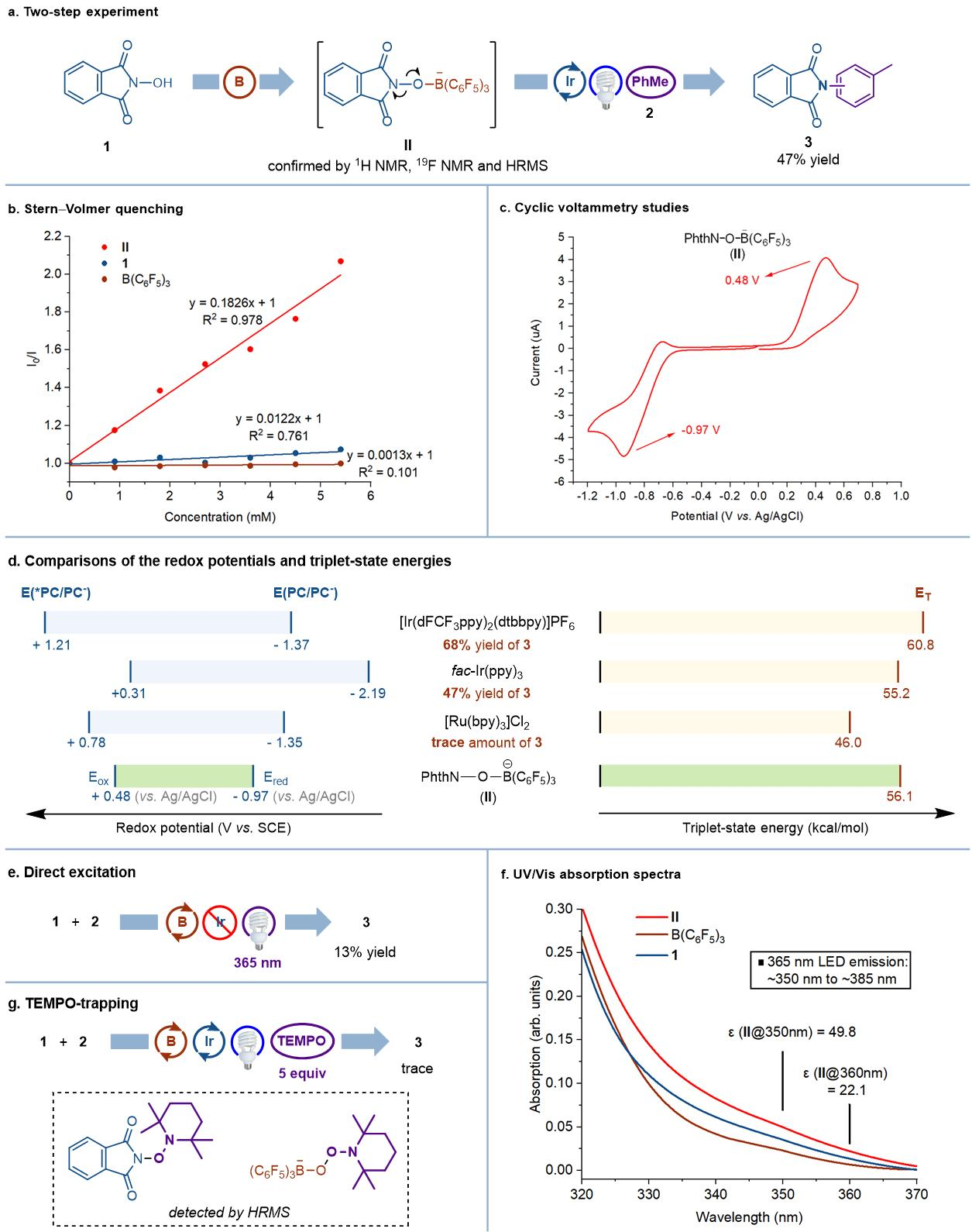
Mechanism Investigation
a) Stepwise experiments; b) Fluorescence quenching experiments; c) Cyclic voltammetry tests; d) Comparison of different photocatalysts; e) Ultraviolet irradiation experiments; f) UV-Vis absorption spectroscopy; g) Free radical trapping experiments
The publication of this achievement coincides with a critical period in which Taizhou University is fully advancing the strategic goals of “upgrading to a higher-level university, applying for doctoral programs, and striving to be first-class.” It provides strong evidence for the accumulation of the university’s research strength and the effectiveness of talent cultivation, while also injecting powerful momentum into accelerating the construction of a regionally top-tier applied university. It is worth mentioning that this paper is the second Nature Communications article published by our university this year, further highlighting our continuous breakthroughs and academic influence in basic research and applied transformation.
Paper link: https://www.nature.com/articles/s41467-025-66712-w