The team led by Professor Fu Yongqian from the School of Life Sciences, in collaboration with Professor Jiang Ling from Nanjing Tech University, has successively published two experimental research papers on chitosanase in Journal of Agricultural and Food Chemistry (IF: 6.2, CAS Zone 1 TOP).
The paper titled “Enhancing Chitosanase Activity via Directed Evolution and Its Molecular Mechanisms” lists Dr. Chen Yao (School of Life Sciences) as the first author, with Professor Fu Yongqian (Taizhou University), Dr. Sun Xiaolong, and Professor Jiang Ling (Nanjing Tech University) as corresponding authors. The second paper, “Combining Signal Peptide Optimization with Directed Evolution to Enhance Chitosanase Activity,” also names Dr. Chen Yao as first author, with undergraduate students Chen Min and Lin Xinli (Biological Sciences program) as co-first authors. The corresponding authors for this paper are Professor Fu Yongqian (Taizhou University), Dr. Yin Fengwei, and Professor Jiang Ling (Nanjing Tech University). Both studies were supported by the Taizhou Science and Technology Plan Project and the National Natural Science Foundation of China.
Research Progress I:
The team fused the rationally designed chitosanase SsCsn46 (mSsCsn46) from Streptomyces sp. N174 with the Escherichia coli OmpA signal peptide, and then applied directed evolution to systematically optimize enzyme performance. The final variant, M1, contains 18 mutations and reached a specific activity of 1680 U/mg—an 812-fold improvement over mSsCsn46. Under continuous substrate feeding for 3 hours, M1 produced 142 g/L chitosan oligosaccharides with a conversion rate of 89.9%. Molecular dynamics simulations suggested that the mutations markedly stabilized interactions between Asn157 and GlcN-3 and expanded the substrate-binding pocket volume to 1483.8 ų. In application tests using fungal chitosan from Aspergillus niger ATCC 1015, M1 converted the substrate to chitosan oligosaccharides within 30 minutes, achieving a 95.1% conversion rate. Overall, this study highlights the power of directed evolution to reshape chitosanase structure and function and supports efficient, industrial-scale enzymatic production of chitosan oligosaccharides.
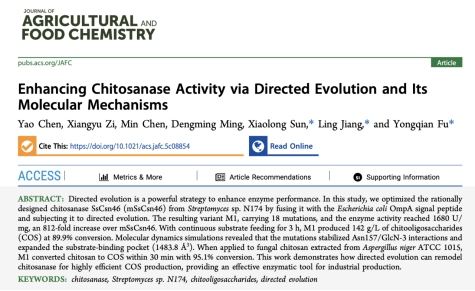
Figure 1 Screenshot of the Paper
Research Progress II:
The team used site-saturation mutagenesis to engineer the native signal peptide of chitosanase Csn168 from Bacillus subtilis 168. By moderately reducing secretion levels, they established a high-resolution screening method based on the hydrolysis-zone phenotype. Using this platform, multiple rounds of directed-evolution screening yielded the M8 mutant, which produced a 28 mm hydrolysis zone within 33 hours and showed catalytic activity about 10 times higher than Csn168. M8 also displayed improved substrate affinity, with Km decreasing from 25.56 g/L to 11.75 g/L. Molecular dynamics simulations further indicated that M8 promotes faster product dissociation after substrate binding, accelerating overall catalytic turnover. Taken together, the results demonstrate that combining fine-tuned signal peptide regulation with directed evolution is an effective strategy for rapid screening and discovery of high-performance chitosanase variants.
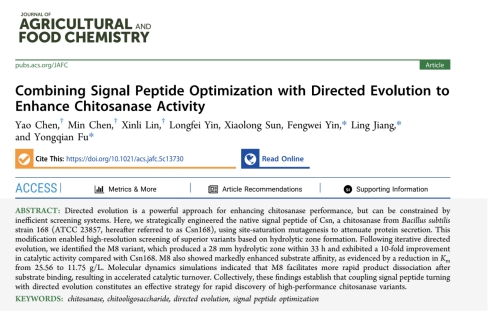
Figure 2 Screenshot of the Paper
Paper link: https://doi.org/10.1021/acs.jafc.5c08854
https://doi.org/10.1021/acs.jafc.5c13730