Dr. Zhao Zhe from the School of Life Sciences, together with collaborators from several domestic and international research institutions, recently developed a new mangrove module (ORCHIDEE-MAN) for the dynamic global vegetation model ORCHIDEE. The module introduces two distinct above-ground root carbon pools specific to mangroves (prop roots and pneumatophores), revises mangrove carbon-allocation schemes, and incorporates processes that account for the effects of salinity and tidal inundation stress on productivity. The team also calibrated key model parameters to improve performance.
The results were published in the leading international journal for model development, Journal of Advances in Modeling Earth Systems, in an article titled “ORCHIDEE-MAN: Incorporating Mangrove Processes in the Global Vegetation Model of ORCHIDEE.” Dr. Zhao Zhe is the first author, and Associate Professor Li Wei (Department of Earth System Science, Tsinghua University) is the corresponding author. The research was supported by the Key Research and Development Program of Hainan Province and the Hainan International Science and Technology Cooperation Research and Development Program, among others.
Mangroves have exceptionally high carbon-sequestration capacity and play an important role in lateral carbon exchange between land and sea. Accurately quantifying mangrove carbon dynamics under climate change and human disturbance is therefore essential for evaluating their potential to mitigate climate change and for informing conservation and management policies. However, most dynamic vegetation models do not explicitly represent mangrove-specific ecological processes, which can introduce biases in simulations of atmospheric carbon uptake by terrestrial ecosystems and in the carbon budgets of tropical countries.
Compared with the default ORCHIDEE version, ORCHIDEE-MAN produces biomass and productivity estimates that better match global site observations. It also broadly reproduces satellite-derived spatial patterns of biomass and captures the observed seasonal productivity dynamics at the Leizhou, Gaoqiao, and Yunxiao flux-tower sites. Overall, ORCHIDEE-MAN provides a useful tool for investigating mangrove carbon-cycling processes and estimating carbon budgets, and it offers a valuable reference for incorporating mangroves into other dynamic global vegetation models.
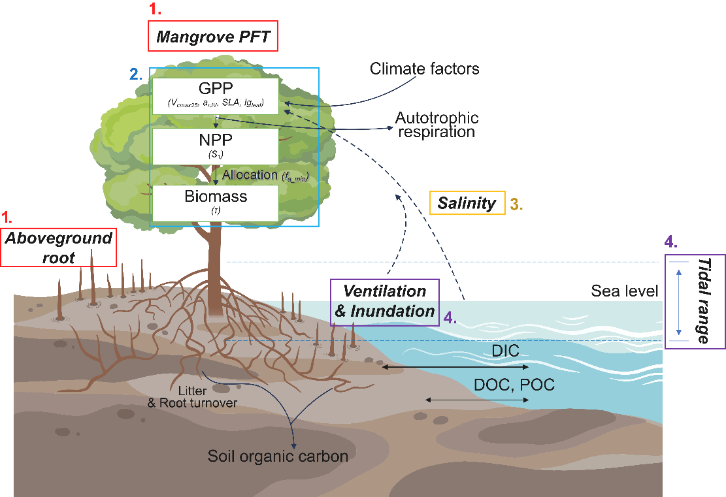
Schematic diagram of the mangrove carbon cycling module in ORCHIDEE-MAN
Paper link: https://agupubs.onlinelibrary.wiley.com/doi/10.1029/2025MS005185