Professor Mark van Kleunen from Taizhou University’s Institute of Global Change and Evolutionary Ecology, as a key co-author, recently published a paper titled “Invasion impacts in terrestrial ecosystems: Global patterns and predictors” in the leading international journal Science. The study was conducted through collaboration among several leading research groups worldwide, including the team led by Madhav P. Thakur at the University of Bern (Switzerland), the team led by Gu Zhizhuang at East China Normal University, the team led by Mark van Kleunen at TU’s Advanced Research Institute, and the team led by Zhou Xuhui at Northeast Forestry University. Zhejiang Provincial Key Laboratory of Restoration for Damaged Ecosystems and the Zhejiang Provincial Key Laboratory of Plant Evolutionary Ecology and Conservation, both at TU, are also listed as co-affiliated institutions on the paper.
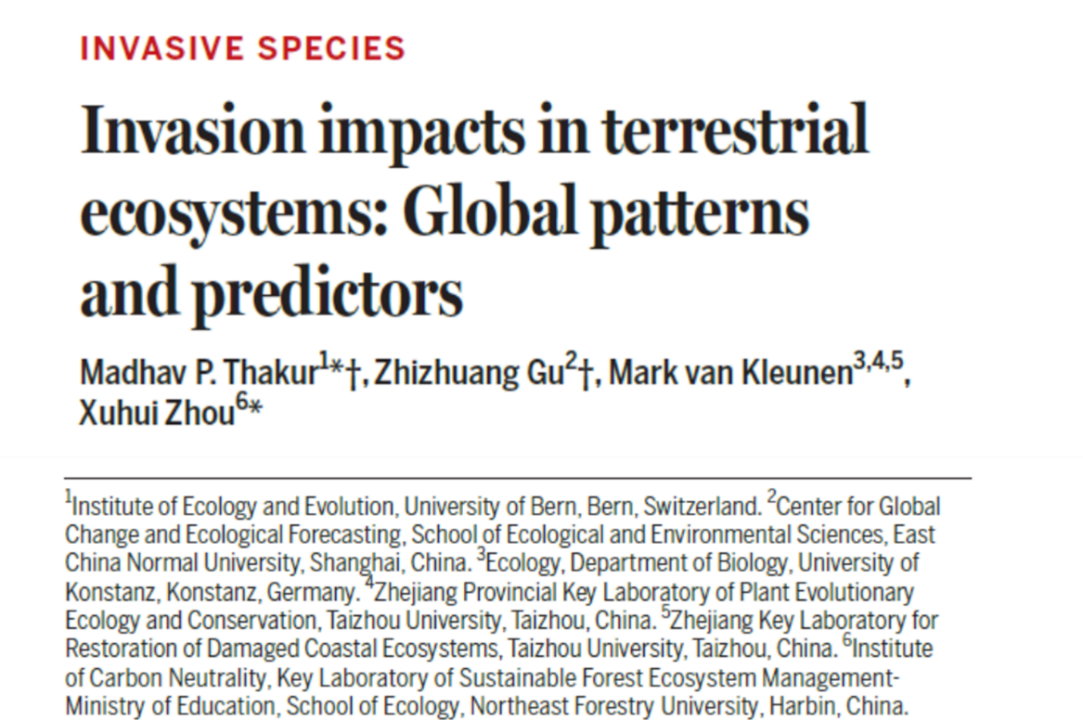
Article Screenshot
Biological invasions are a major driver of global biodiversity loss and changes in ecosystem functioning, yet their impacts vary greatly across ecological contexts, complicating invasive-species management. To address this challenge, the research team carried out a large-scale meta-analysis of 775 studies, encompassing 2,223 effect sizes across terrestrial ecosystems worldwide. The analysis examined the impacts of three major groups of invaders—plants, animals, and microorganisms—on 15 key ecosystem attributes, resulting in what the authors describe as the most comprehensive database of invasion impacts to date.
The study found that the most consistent negative effect of invasive plants is a reduction in native plant diversity. It also showed that invasive plants and invasive animals are both associated with increased soil greenhouse gas emissions. One of the study’s key advances is identifying the importance of residence time: as invasive species persist longer in an area, their negative effects on native plant diversity become stronger, whereas their influence on soil abiotic properties may weaken over time. By quantifying the context-dependence of invasion impacts using a global dataset, the research highlights the temporal dimension of invasions and provides an important scientific basis for developing more targeted strategies for invasive-species management and biodiversity conservation.