The research team led by Professor Lu Shirong from the School of Materials Science and Engineering published a research paper titled “Allylrhodanine-processed all-small-molecule organic solar cell achieves an 18.43% efficiency breakthrough” in the authoritative journal Nature Communications. Professor Lu Shirong and specially appointed researcher Zhong Lian are the corresponding authors, jointly supervised doctoral student Cao Duoling is the first author, and Taizhou University is the first affiliation.
The paper Lu Shirong’s Team Published in Nature Communications
All-small-molecule organic solar cells exhibit significant industrial potential due to their well-defined molecular structures and excellent batch stability. However, their strong crystallinity has long constrained performance improvements by causing excessive phase separation.
This paper innovatively employs the volatile solid additive 3-allylrhodanine (3-AR), which structurally resembles the terminal group of the donor MPhS-C2, to achieve precise control over the active layer morphology. Theoretical calculations and morphological characterization jointly reveal that 3-AR, through thermodynamically selective interactions with the acceptor N3, effectively suppresses excessive crystallization and aggregation of the donor and acceptor during the kinetic process. This guides the formation of an ideal nanoscale bicontinuous interpenetrating network structure and significantly enhances vertical uniformity. The optimized morphology synergistically promotes efficient charge dissociation and transport while suppressing bimolecular and trap-assisted recombination. Ultimately, the device achieves a power conversion efficiency of 18.43% (third-party certified 18.16%), setting a new record for the highest efficiency in binary all-small-molecule solar cells.
This research not only sets a new international efficiency record but also further advances the commercialization process of organic solar cells.
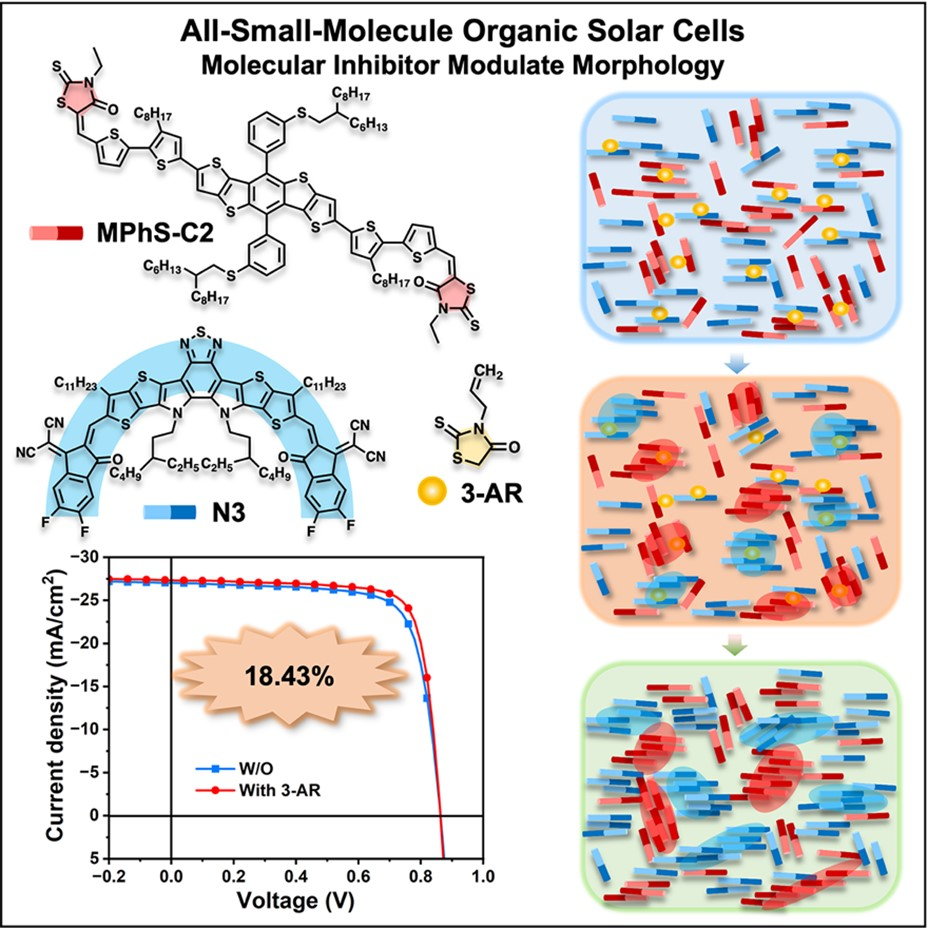
A chart from the paper Lu Shirong’s Team Published in Nature Communications
Paper link: https://www.nature.com/articles/s41467-026-68924-0