Professor Cao Xuan’s team from the Medical School published a research paper titled “Engineered lipid hybrid nanoparticles for targeted delivery of SH2 superbinder and breast cancer therapy” in the Journal of Nanobiotechnology (a Top-tier journal in CAS Zone 1, IF: 12.6, immediate IF: 14.9).
SH2 superbinder protein (SH2S) is an engineered polypeptide modified based on the SH2 domain, which significantly enhances its binding capacity to tyrosine-phosphorylated proteins and can be used for the diagnosis and treatment of various cancers. However, issues such as poor serum stability and insufficient tumor targeting limit its clinical application efficacy.
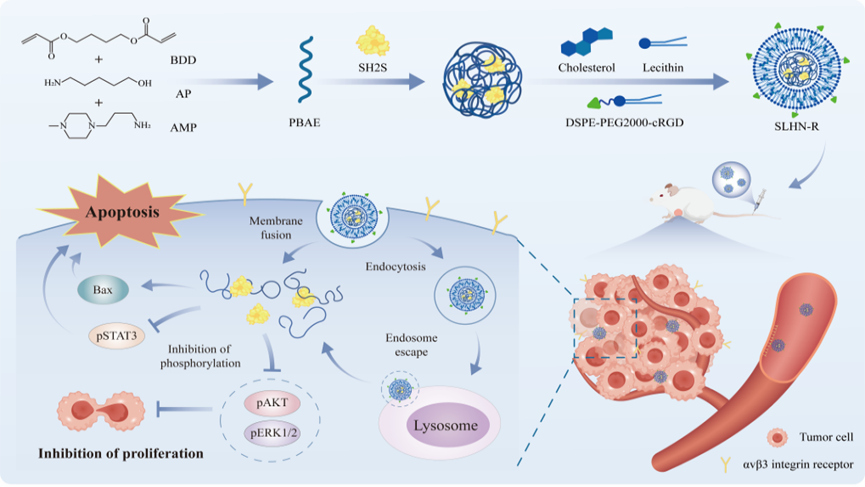
Schematic Diagram of SLHN Antitumor Mechanism
To address the aforementioned technical challenges, this research utilized the cationic polymer poly(β-amino ester), lipids, and cholesterol to construct SH2S-loaded lipid hybrid nanoparticles (SLHN) via an improved microfluidic technique. SLHN efficiently delivers SH2S into tumor cells through membrane fusion and clathrin-mediated endocytosis. Upon cellular entry, SLHN competitively displaces endogenous SH2 domain-containing proteins, inducing tumor cell apoptosis and inhibiting proliferation by blocking the phosphorylation of AKT, ERK, and STAT3. Furthermore, the cRGD peptide-modified SLHN demonstrates enhanced tumor-targeting capability, enabling efficient treatment of breast cancer at lower dosage levels with milder adverse reactions. The results indicate that SLHN exhibits excellent anti-breast cancer efficacy both in vitro and in vivo. After active targeting modification with cRGD, its therapeutic effect is further enhanced. This modification strategy enriches the application of lipid delivery systems in anticancer protein delivery and enhances the clinical application value of SH2 super-affinity proteins.
Jointly supervised graduate students Zhu Yuhe and Sang Yazhou, along with young faculty member Du Linna from the Medical School, are co-first authors. Professor Cao Xuan is the last-listed corresponding author. Taizhou University is the first affiliation. This research was supported by the National Natural Science Foundation of China General Program (81974468).
Professor Tony Pawson from the University of Toronto School of Medicine discovered the SH2 domain and pioneered the modular signal transduction theory of proteins. He systematically elucidated the molecular mechanism by which the SH2 domain mediates protein interactions by recognizing phosphorylated tyrosine, thereby constructing dynamic cellular signaling networks. This discovery has transformed multiple fields, including cellular signal transduction, cancer research, and precision medicine, and has advanced the development of cancer-targeted drugs (such as tyrosine kinase inhibitors). He has received international honors including the Wolf Prize in Medicine (2005), the Kyoto Prize (2008), and the Thomson Reuters Citation Laureate (2012, nominated for the Nobel Prize in Physiology or Medicine).
Professor Li Shuncheng from Western University in Canada has continued and systematically expanded upon Tony Pawson’s work on the SH2 domain, making creative extensions. The SH2 Superbinder protein is a PCT international invention patent jointly held by Professor Li Shuncheng, Professor Cao Xuan, and other researchers. Based on this patented technology, Jiahua Yaorui Technology (Beijing) Co., Ltd. was established, focusing on clinical proteomics technology research and development, and has secured strategic investments amounting to hundreds of millions of yuan.
Professor Cao Xuan’s team has conducted in-depth research on the anti-tumor effects of the SH2 Superbinder protein. In recent years, they have published a series of research papers as co-authors in Science Signaling (a Science sub-journal) and Nature Chemical Biology (a Nature sub-journal), and as corresponding authors in ANAL CHIM ACTA (top journal, IF: 6), JECCR (Zone 1, IF: 12.8), CLIN TRANSL MED (Zone 1, IF: 10.6), Cell Death & Disease (Zone 1, IF: 9.6), and Journal of Nanobiotechnology (Zone 1, IF: 12.6). Additionally, they have obtained one authorized PCT international patent as the third inventor and three authorized Chinese invention patents as the first inventor. The aforementioned research papers and invention patents have laid a solid foundation for the industrial development of SH2 Superbinder protein in anti-tumor diagnosis and treatment.
Paper link: https://link.springer.com/article/10.1186/s12951-026-04249-w