Wu Xianju, a faculty member of the School of Intelligent Manufacturing at Taizhou University, conducted systematic research during his doctoral studies on the combustion mechanism of boron-based high-energy fuels and their application in solid-fuel scramjet engines, yielding a series of innovative results. The related papers have been successively published in the top international combustion journal Combustion and Flame (SCI Q1 TOP, titled “Multiphase Ignition and Combustion Model and Its Characteristics of Boron Particles Based on Dynamic Experimental Phenomena”), the authoritative national defense journal Defence Technology (SCI Q1 TOP, titled “Performance Comparison of Full-Scale Ramjet and Scramjet Using Boron-Based Propellant”), and China’s leading outstanding journal Acta Aeronautica et Astronautica Sinica (titled “Combustion enhancement effect of dual combustor ramjet engines on boron-based propellants”). All three papers were led by the first author Wu Xianju, completed in collaboration with Professor Wei Zhijun and Professor Wang Ningfei’s team from Beijing Institute of Technology.
Boron possesses extremely high mass calorific value and volumetric calorific value, making it an ideal high-energy fuel for solid-fuel ramjet/scramjet engines. However, the long-standing critical bottlenecks of boron particles, such as ignition difficulty, self-repair of the oxide layer, and incomplete combustion, constrain their engineering application. To address the pain points of boron-based propellants—“difficult ignition, slow de-coating, and short residence time”—the Wu Xianju team, following the mainline of “mechanism modeling, law revelation, and engine validation,” conducted a full-chain study from microscopic combustion mechanisms to overall engine performance evaluation.
In terms of fundamental mechanism innovation, the team systematically improved the classic PSU boron combustion model based on dynamic combustion experimental phenomena, establishing a wide-operating-condition multiphase ignition and combustion model for boron particles. The model for the first time fully incorporates the dynamic evolution of the oxide layer, reversible phase transitions of boron particles, and the coupling process of physical property parameters with pressure, achieving a mathematical description from ignition delay and oxide layer removal to liquid/solid-phase multi-stage combustion.
The study reveals the quantitative regulatory rules of particle size, ambient temperature and pressure, oxygen concentration, and water vapor on combustion mode transition. It clarifies that increasing ambient temperature and humidity can significantly promote the shift of combustion toward a diffusion-controlled mode, thereby providing a theoretical basis for efficient ignition and enhanced combustion of boron particles. This model breaks through the limitations of traditional models in describing the dynamic evolution of oxide layers and phase transition processes, improving prediction accuracy by 19.9% to 42.5% compared to conventional PSU models. It can provide reliable mechanistic support for three-dimensional CFD simulations of engines.
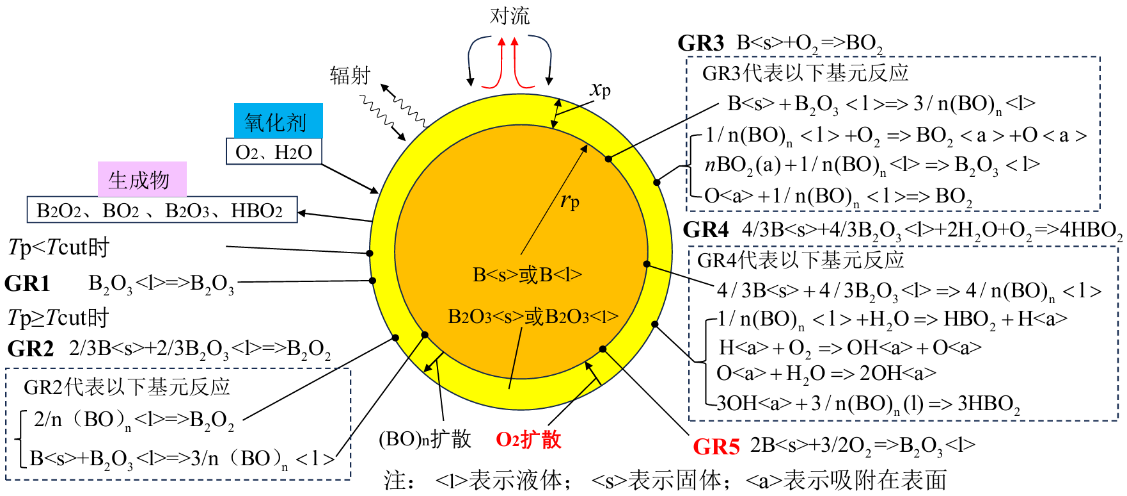
(a) Oxide layer removal stage
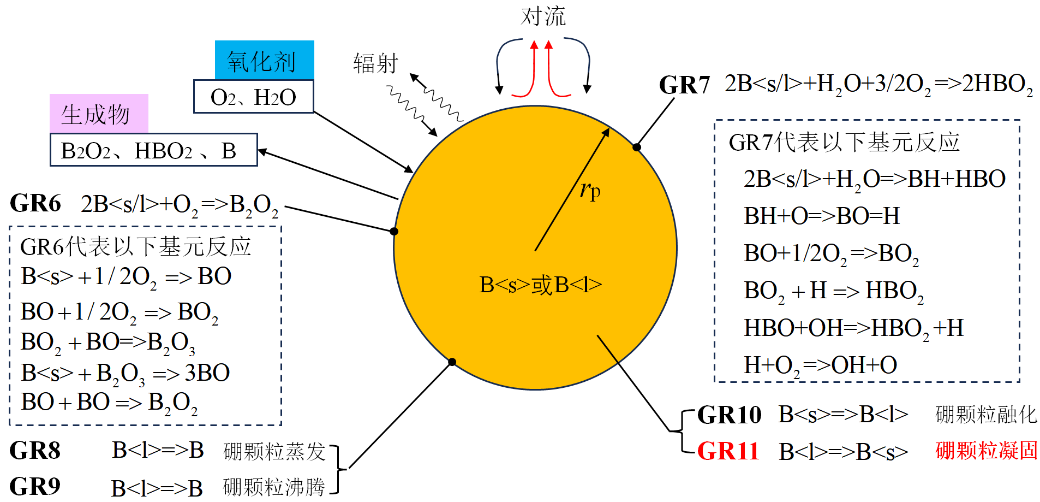
(b) Pure Boron Combustion Stage
Figure 1: Corrected Boron Particle Ignition and Combustion Model (xp represents oxide layer thickness; rp represents boron particle radius; Tp represents boron particle temperature; Tcut represents the critical ignition temperature.)
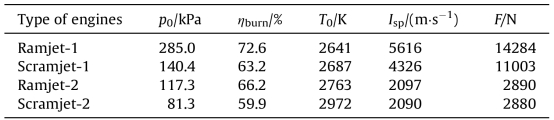
In terms of engineering application translation, the team successfully applied the high-precision combustion model to the three-dimensional numerical simulation of full-scale Ramjet and Scramjet engines, achieving, for the first time, performance benchmarking of boron-based fuel for both types of full-scale engines. Research indicates that the performance demarcation point for boron-based propellant engines lies near Mach 7: under Mach 6 conditions, the specific impulse of the Ramjet is 1290 m/s higher than that of the Scramjet, showing a significant advantage; under Mach 7 conditions, the performance of the two engines becomes comparable.
The study indicates that the high temperature and pressure, along with the extended particle residence time in the subsonic combustion chamber, can significantly enhance the burnout rate of boron particles. However, the high static temperature promotes boron vaporization and B₂O₂ dissociation, suppressing total temperature rise. Although the combustion efficiency of the scramjet is slightly lower, gas-phase dissociation is weaker, offering greater potential for high Mach numbers. The relevant conclusions provide critical data support for the power system selection, operating condition matching, and combustion chamber optimization design of hypersonic vehicles.
Table 1 Overall performance comparison of two types of ramjet engines
The team further advanced research on dual-combustor ramjet engines, proposing a staged combustion technical scheme for subsonic/supersonic tandem combustion. This approach specifically targets the industry-wide challenge of low combustion efficiency in boron-containing solid-fuel ramjets, effectively alleviating the technical bottlenecks of boron particles, including “difficult ignition, slow de-coating, and short residence time.” It achieves efficient energy release and a breakthrough in specific impulse performance, providing a new pathway for the engineering application of boron-based propellants in wide-speed-range hypersonic propulsion systems.
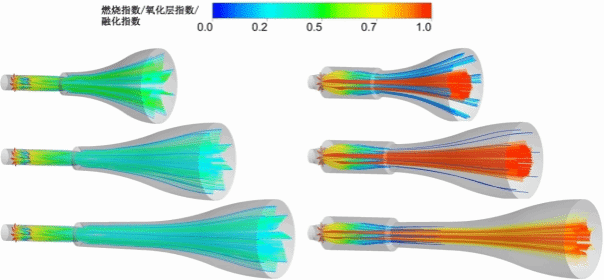
Figure 2: Boron particle combustion indices for the two engine types along particle trajectories
These three papers are mutually supportive and organically unified, forming a complete innovation chain from “microscopic mechanism breakthroughs to engine application validation.” The research outcomes not only deepen the scientific understanding of boron-based fuel combustion mechanisms but also provide theoretical support for the design optimization and engineering application of solid-fuel scramjet engines in China.
This research was supported by the Key Support Project of the National Natural Science Foundation of China (No. U21B2086) and the Project of Taizhou Municipal Science and Technology Bureau (No. 2002gy07).
Paper link: https://doi.org/10.1016/j.dt.2025.08.013
Paper link: https://doi.org/10.1016/j.combustflame.2024.113445
Paper link: https://doi.org/10.7527/S1000-6893.2025.31788