The team led by Professor Cao Xuan from the School of Medicine/Institute for Advanced Study, at the invitation of Experimental Hematology & Oncology, a renowned international journal in oncology (Top journal in both general and specialized categories of the Chinese Academy of Sciences, IF: 13.5, immediate IF: 17.4), published a review paper titled “Epigenetic and post-translational regulatory networks of ferroptosis in the tumor immune microenvironment” in this journal. Dr. Du Linna, a young faculty member at the team, is the first author, with Professor Cao serving as the corresponding author. Taizhou University is the sole affiliated institution.
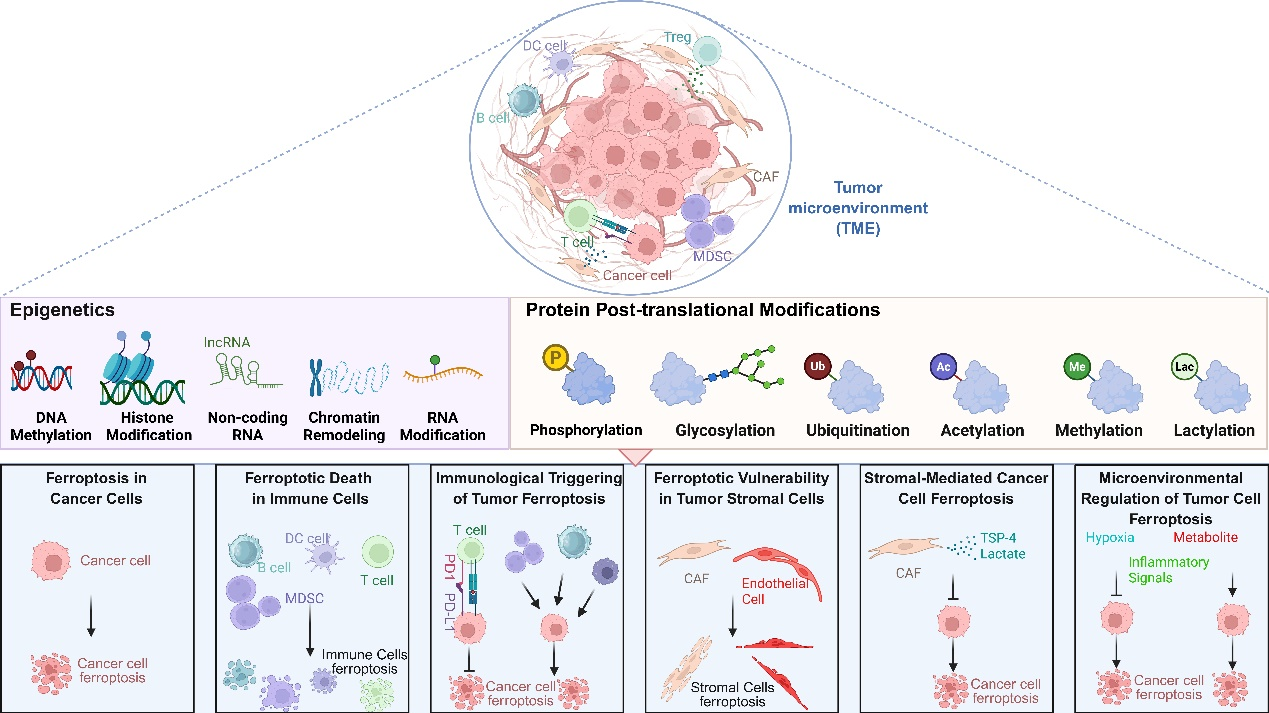
Schematic diagram of epigenetic and post-translational regulatory networks of ferroptosis in the tumor immune microenvironment
Ferroptosis is a non-apoptotic cell death mechanism characterized by iron-dependent lipid peroxidation of cell membranes. In recent years, significant progress has been made in elucidating the multi-level regulatory mechanisms of ferroptosis within the tumor immune microenvironment (TIME), encompassing two major layers: epigenetic modifications and post-translational regulation of proteins. Epigenetic mechanisms include DNA methylation, histone modifications, non-coding RNA regulation, and chromatin remodeling, while post-translational modifications (PTMs) involve phosphorylation, glycosylation, ubiquitination, acetylation, methylation, and lactylation of key ferroptosis-related proteins.
This review summarizes the complex interconnections among the tumor immune microenvironment, ferroptosis, and the aforementioned dual regulatory networks, with a focus on how epigenetic processes and post-translational modifications synergistically regulate ferroptosis mediators within the tumor immune microenvironment. It analyzes the regulatory role of ubiquitination in protein stability, as well as how metabolic modifications such as lactylation couple cellular metabolism with ferroptosis regulation. These multi-level interactions collectively form a complex regulatory network that influences tumor progression, immune evasion, and therapeutic resistance.
The cross-regulation between epigenetics and post-translational modifications determines the ferroptosis susceptibility of different cell types within the tumor immune microenvironment, with tumor cells and immune infiltrating cells exhibiting distinctly different modification patterns. Furthermore, this article introduces emerging therapeutic strategies that simultaneously target the epigenetic and post-translational regulation of ferroptosis, including combination treatment regimens designed to enhance ferroptosis induction through the modulation of specific modifying enzymes. A thorough elucidation of these complex multi-level regulatory relationships can provide an important theoretical basis for the development of novel precision tumor treatment strategies based on ferroptosis regulation, demonstrating significant clinical application value.
This paper was supported by the General Program of the National Natural Science Foundation of China (82473945) and the Taizhou Anti-Cancer Association Tumor Special Research Project (TACA2025-A02), among other projects.
Paper link: https://pubmed.ncbi.nlm.nih.gov/41588554/