Liu Yang’s team from the School of Intelligent Manufacturing (Aeronautical Engineering) published a research paper titled “Experimental evaluation on bubble coalescence and breakup criteria in an air-sparged bubble column” in the internationally renowned journal Separation and Purification Technology (a Top journal of the Chinese Academy of Sciences, with an impact factor of 9.0). The first author, Dr. Liu Yang, and the first affiliation are both from Taizhou University.
Bubble coalescence and breakup are key dynamic processes in gas-liquid two-phase turbulence. Due to the influence of complex factors such as the spatiotemporal evolution of turbulent structures, the nature of flow, and multiphase interactions, the understanding of these mechanisms remains incomplete. A deep understanding of bubble dynamics in multiphase turbulent flows is of great significance for the design and optimization of power engineering, industrial reactors, and bioreactors.
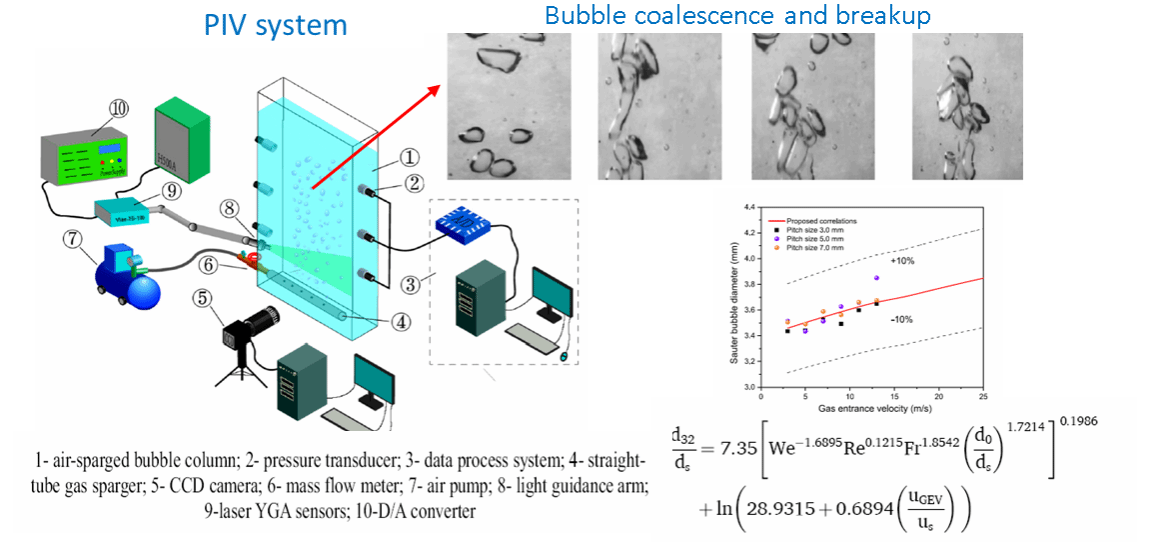
This study focuses on the coalescence and breakup processes of complex bubbles in bioreactors. Using a particle image velocimetry (PIV) system, experiments were conducted to investigate the generation, development, and turbulent evolution of bubble coalescence and breakup, elucidating the effects of nozzle spacing, nozzle diameter, nozzle number, and gas inlet velocity on the dynamic changes in bubble size distribution. Based on this, a semi-empirical correlation was developed, coupling gas inlet velocity, Reynolds number, Weber number, Froude number, and injector structural parameters, to accurately predict the Sauter mean bubble diameter in the reactor. Threshold conditions for bubble coalescence and breakup were also proposed.
The study revealed the characteristics of bubble turbulent flow and the variation patterns of dynamic parameters, providing important theoretical and engineering foundations for enhancing heat and mass transfer efficiency in reactors and optimizing the Reynolds stress distribution of bubbles and the liquid phase.
This research was supported by Zhejiang Provincial Natural Science Foundation (LTGY24E060001).
Paper link:
https://www.sciencedirect.com/science/article/pii/S1383586626010178?via%3Dihu