Dr. Xiong Xianqiang from the School of Pharmaceutical and Chemical Engineering published a research paper titled “Gradient Valence Engineering Synchronizes Charge-Carrier and Catalytic Dynamics for Efficient Solar Water Oxidation” in the internationally renowned top-tier chemistry journal Angewandte Chemie International Edition (IF=16.6).
Inspired by the precise spatiotemporal synergistic mechanism in natural photosystem II, this work proposes a novel “gradient valence engineering” strategy to address the long-standing kinetic mismatch of “fast separation, slow reaction” in photoelectrochemical water splitting. By controllably constructing an amorphous Fe-HOTP metal-organic framework (MOF) layer on the surface of a bismuth vanadate (BiVO4) photoanode and employing precise reduction-oxidation treatments, this work successfully creates a continuous valence gradient within the MOF layer, ranging from electron-rich Feδ+ (δ<2) at the semiconductor interface to highly oxidized Fe3+ at the electrolyte interface. This innovative architecture simultaneously achieves ultrafast hole injection (<5 ps), a substantial extension of carrier lifetime to 0.03 seconds, and a high catalytic turnover frequency of 82 s-1 at the surface Fe3+/Fe4+ active sites, thereby perfectly synchronizing the dynamics of charge separation and surface water oxidation in both space and time. Benefiting from this spatiotemporal synergy, the photoanode achieves a high photocurrent density of 6.1 mA cm-2 under standard illumination, with a decay of only 2% over 30 hours of continuous testing. When tandem with a silicon solar cell, it attains a bias-free solar-to-hydrogen conversion efficiency of 4.58%. Furthermore, the system demonstrated a 61% selectivity and high yield in the selective oxidation of glycerol to dihydroxyacetone, highlighting its excellent general applicability.
This research provides a novel design paradigm and theoretical guidance for the development of efficient and stable artificial photosynthetic systems. Dr. Xiong Xianqiang is the first corresponding author of the paper, and Taizhou University is the first corresponding unit.
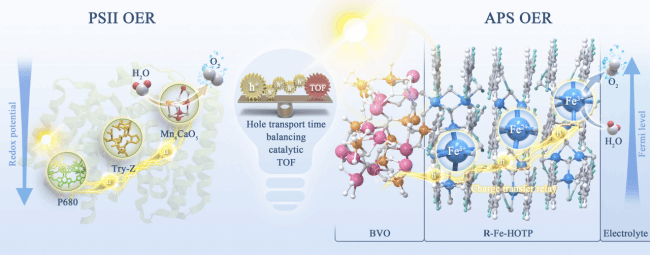
Material Design Strategy
Paper link: https://doi.org/10.1002/anie.5670116