The team led by Dr. Chen Zui from the Road, Bridge, and River-Crossing Engineering Discipline Group of the School of Civil Engineering and Architecture published their latest research titled “Dynamic fatigue life prediction of ballastless track under high-frequency train vibrational loads” in Engineering Structures (latest impact factor: 7.61), a world-renowned top-tier journal in the field of structural engineering, a CAS Zone 1 TOP journal, and a landmark journal of science and engineering. This study focuses on the prediction of dynamic fatigue life of ballastless tracks in high-speed railways under high-frequency train vibrational loads. Dr. Chen Zui is the first author of the paper, and Taizhou University is the first affiliation.
The safe and stable operation of high-speed railways relies on the long-term stable service of track structures. Ballastless track is an important foundational structure widely used in high-speed railways, which is characterized by good smoothness and high stability. However, during long-term high-speed train operations, the track slab continuously endures repeated loads and vibrations. In particular, track irregularities can induce high-frequency, random additional vibrations, which accelerate fatigue damage to concrete track slabs over prolonged service. Traditional fatigue assessment methods, mostly based on static or quasi-static loads, struggle to fully reflect the impact of complex vibrations on structural lifespan under high-speed train operating conditions. Therefore, how to more accurately predict the fatigue life of ballastless tracks under real service conditions is a critical issue for ensuring the long-term safe operation and scientific maintenance of high-speed railways.
To address this problem, this paper establishes a dynamic fatigue life prediction method that integrates vehicle-track coupled dynamic analysis, power spectral density equivalent processing, concrete frequency-dependent fatigue life equations, and nonlinear damage accumulation criteria. The study converts the complex vibration loads generated during high-speed train operation into equivalent fatigue loads suitable for engineering calculations, and combines acoustic emission fatigue tests to reveal the damage evolution law of concrete.
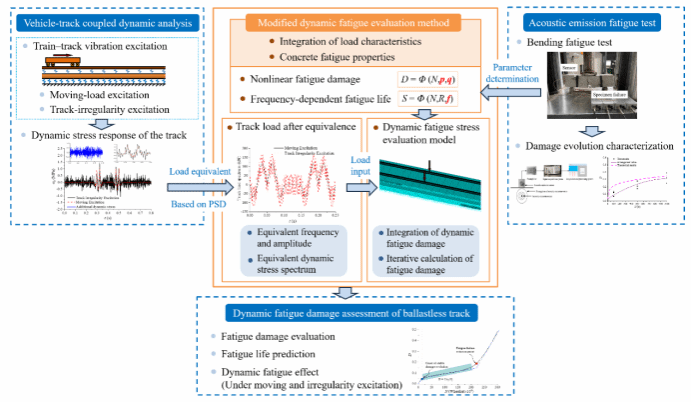
The research results indicate that within the existing high-speed railway operating speed range, the impact of pure train moving loads on the fatigue damage of ballastless tracks is relatively limited, while high-frequency vibrations induced by track irregularities are a significant factor accelerating the fatigue damage of track slabs. Taking an operating speed of 350 km/h as an example, after accounting for track irregularities, the predicted fatigue life of the track slab decreases from 174 years to 119 years, equivalent to enduring an equivalent fatigue effect approximately 3.6 times the static wheel load. These findings can provide theoretical basis and technical support for the fatigue design, life assessment, and maintenance decision-making of high-speed railway ballastless tracks.
This research was supported by the National Natural Science Foundation of China, the Taizhou Science and Technology Project, and the National Key Research and Development Program of China.
Paper link: https://doi.org/10.1016/j.engstruct.2026.122995