Recently, the research paper Engineering lattice and defects of nanosized metal halide perovskite via nickel doping for efficient X-ray imaging by Wang Rufeng, a postgraduate student from the School of Materials Science and Engineering, has been published online in the internationally renowned journal Nano Research. The journal is a CAS Top journal, ranked in Tier 1 in both the major and minor categories. Wang Rufeng is the first author of the paper, and Dr. Pu Guiqiang, a member of the research team, serves as the co-corresponding author. Taizhou University is the first affiliation.
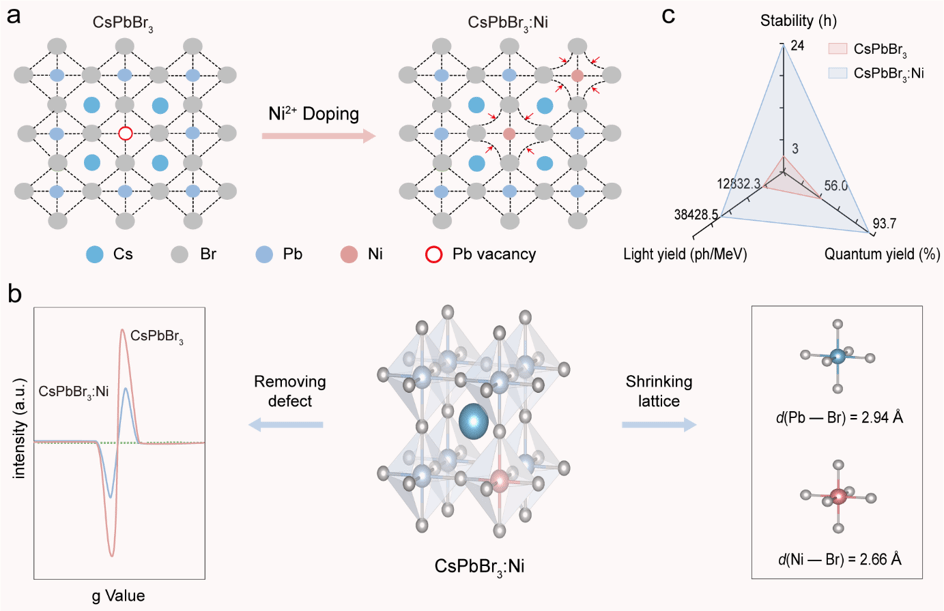
Figure1 (a) Schematic illustration of the introduction of Ni2+ into the lattice of CsPbBr3, effectively suppressing vacancy formation. (b) The effect of Ni2+ doping on defects and lattice in CsPbBr3. The Ni2+ doping could remove the defects and shrink the lattice. (c) The satellite map of PLQY, LY, stability for both CsPbBr3 and CsPbBr3: Ni.
Metal halide perovskites (e.g., CsPbBr3) have emerged as highly promising scintillator materials owing to their superior optoelectronic characteristics. However, their practical deployment is constrained by intrinsic structural instability and nonradiative recombination-induced energy loss. Herein, the group proposes that Ni2+ doping constitutes a potent regulatory strategy for synergistically improving the scintillation performance and environmental robustness of CsPbBr3 perovskite (Figure 1). Various characterizations combined with theoretical calculation indicate that the incorporation of Ni2+ dopants triggers lattice contraction, thereby enhancing the resistance to environmental perturbations. Ni-doping also passivates intrinsic defects and traps, leading to marked suppression of nonradiative recombination pathways. This synergy in as-prepared Ni-doped CsPbBr3 leads to an 11-fold enhancement in photoluminescence intensity and a substantial increase in photoluminescence quantum yield from 56.0% to 93.7%. Notably, it delivers an exceptional light yield of 38,428.5 photons/MeV, a low detection limit of 64.9 n Gyₐᵢᵣ/s, and superior radiation tolerance. Furthermore, a flexible scintillation screen containing Ni-doped CsPbBr3 enables high-resolution X-ray imaging with a spatial resolution of 16.6 lp/mm, notably surpassing that of the majority of reported perovskite-based scintillators. This study provides profound insights into the pivotal role of metal doping into halide perovskites for enhancing environmental stability in radiation detection technologies.
Link to the original paper:
https://www.sciopen.com/article/10.26599/NR.2026.94908817