Recently, the research team led by Professor Lu Shirong from the School of Materials Science and Engineering has made important progress in the field of all-small-molecule organic solar cells (ASM-OSCs). By adopting a novel additive based on spherically symmetric halogenated adamantane, the team successfully boosted the power conversion efficiency (PCE) of the devices to 18.47%, setting a new record for binary systems. The related research findings have been published in SCIENCE CHINA Chemistry, a CAS Tier 1 Top journal, under the title of “Achieving 18.47% efficiency in all-small-molecule organic solar cells via a spherically symmetric halogenated adamantane-based additive”. Professor Lu and Distinguished Researcher Zhong Lian are the co-corresponding authors. Cao Duoling and Sun Jintong serve as the co-first authors. Taizhou University is the first affiliation.
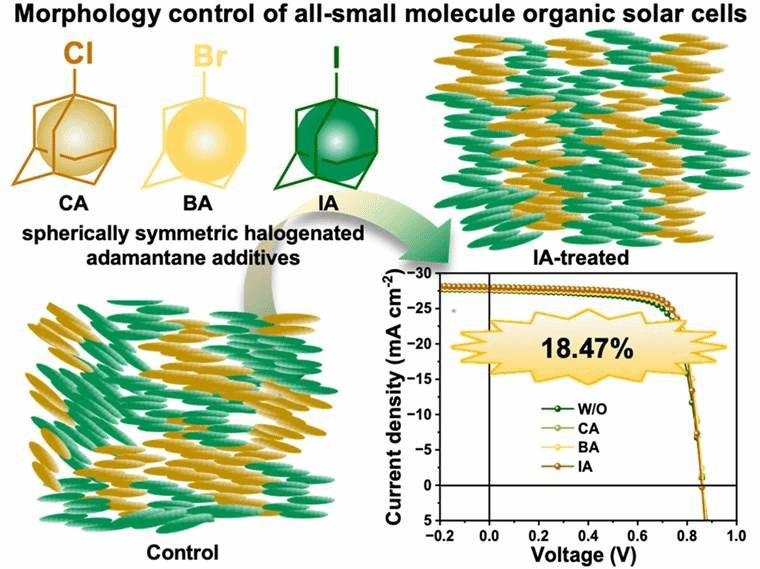
To address the critical challenge of fine-tuning the active layer morphology in all-small-molecule organic solar cells (ASM-OSCs), which limits further enhancement of device power conversion efficiency (PCE), the group introduces a morphology control strategy based on a series of spherically symmetric halogenated adamantane additives (1-chloroadamantane (CA), 1-bromoadamantane (BA), and 1-iodoadamantane (IA). Among them, IA delivers optimal device performance via morphology modulation. Benefiting from its unique molecular structure and strong intermolecular interactions, the additive effectively prolongs the nucleation and crystal growth time of the film. This leads to the formation of the active layer morphology featuring highly ordered molecular stacking, appropriate phase separation scale, and reduced defect-state density. Based on this strategy, the devices achieve efficient and balanced charge transport while significantly suppressing non-radiative recombination losses. Ultimately, when processed with the IA additive, the MPhS-C2:N3-based binary ASM-OSC yields a record PCE of 18.47%. This work not only elucidates the critical role of the highly symmetric spherical structure of halogenated adamantane in morphology control but also opens a new direction for its application in organic photovoltaic devices.
Link to the original paper:
https://www.sciengine.com/SCC/doi/10.1007/s11426-026-3794-0