Recently, the research team led by Principal Investigator (PI) Cao Xuan from the School of Medicine & Institute of Advanced Study has published a research article entitled Corynoxine Inhibits Tumor Growth via Targeting NQO1 and Modulating the PTPA–NQO1/PP2A Switch to Activate PP2A in Advanced Science (IF: 14.1, 5�year IF: 15.6). The paper was also selected as the back cover article for Issue 60 of the journal.
The development of cancer is closely associated with an imbalance in cellular signaling networks. Among these, the sustained activation of pro-proliferative signaling pathways such as PI3K/AKT and MAPK/ERK in multiple tumors is a key factor driving tumor cell growth and survival. Protein phosphatase 2A (PP2A), as an important “tumor suppressor phosphatase” within cells, is capable of dephosphorylating multiple key kinases. However, PP2A activity is commonly suppressed in various solid tumors and hematological malignancies. Therefore, how to reactivate PP2A by using small molecules has become a research direction of considerable interest in the field of cancer therapy.
Corynoxine (Cory) is a natural indole alkaloid isolated from the traditional medicinal herb Uncaria rhynchophylla. Previously, Professor Cao’s research team has discovered that Cory can suppress lung cancer cell growth by activating PP2A, but its direct targets and the molecular mechanism by which it activates PP2A remain unclear.
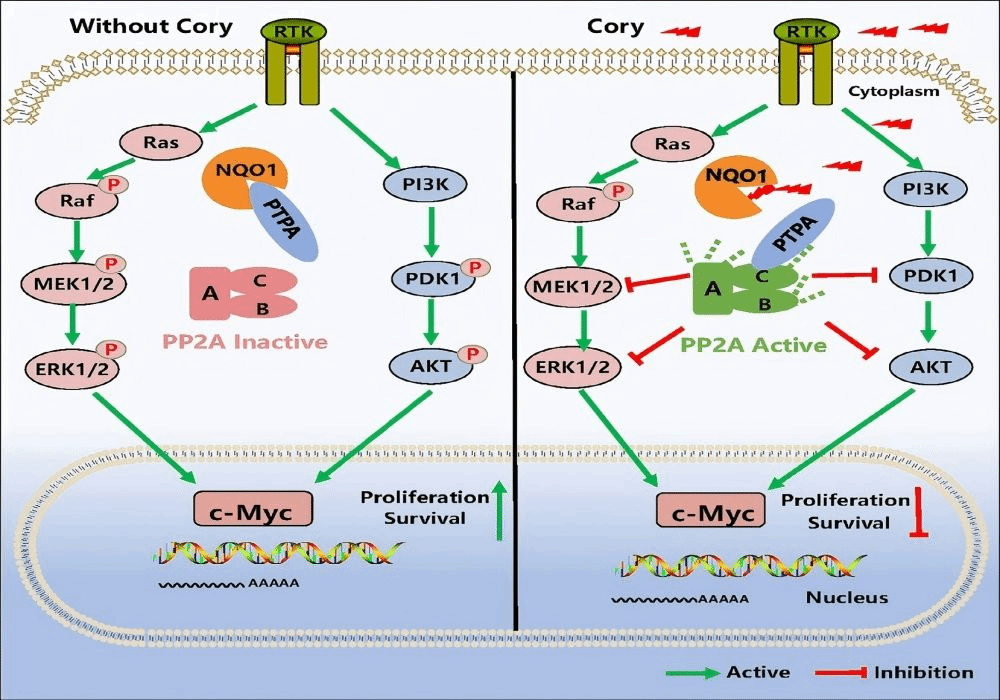
Schematic diagram of the anti-tumor target and molecular mechanism of Cory
This study is the first to report that the natural small molecule Cory acts as an NQO1–PTPA protein–protein interaction inhibitor, releasing PTPA by targeting the Gly193/His194 sites and activating the PP2A pathway, thereby exerting anti-tumor effects at multiple levels. Unlike drugs that directly and broadly alter PP2A holoenzyme assembly, Cory mainly intervenes at the NQO1–PTPA protein interaction interface, exhibiting dependence on the NQO1 expression background and potentially providing more precise intervention effects. Therefore, NQO1 is expected to serve as both a therapeutic target and a patient stratification biomarker. This finding not only provides a novel candidate drug for precision cancer therapy, but also opens a new direction for the targeted regulation of the PTPA–NQO1/PP2A molecular switch in the treatment of malignant tumors.
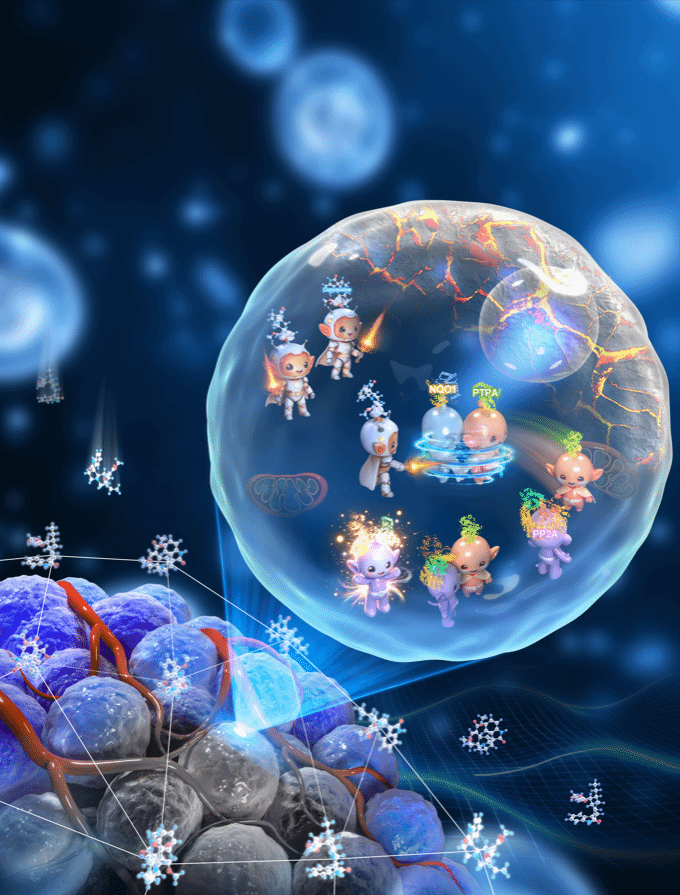
Back-cover image of Advanced Science, Issue 60
Postgraduate student Hou Guoqing is the first author, Lin Li is the co-first author, and Cao Xuan is the corresponding author of the paper. Du Linna serves as the co-corresponding author. Students from the School of Medicine, Zhang Yaoyao, Liang Ruohan, and others are co-authors. The School of Medicine, Taizhou University, is the first affiliation for all authors. This research was supported by the General Program of the National Natural Science Foundation of China (Grant No. 82473945) and other funding programs.
Link to the original paper:
https://doi.org/10.1002/advs.77362