A research paper titled “Effect of Inlet Air Distribution on the Performance of a Boron-Fueled Triple-Combustion Ramjet” has been published in Aerospace Science and Technology, a leading international journal in aerospace engineering. The study was carried out by an undergraduate student under the supervision of Wu Xianju, a faculty member of the School of Intelligent Manufacturing (Aeronautical Engineering) at Taizhou University, and was completed in collaboration with the team led by Professor Wei Zhijun of Beijing Institute of Technology.
The journal is currently listed in Zone 1 (Top) of the Chinese Academy of Sciences journal ranking and is indexed in the Science Citation Index; it carries considerable influence in aerospace engineering. Lin Zhihao, an undergraduate in the Unmanned Aerial Vehicle Systems Engineering program who enrolled in 2024, is the first author of the paper, and Wu Xianju is the corresponding author. TU is listed first among the institutional affiliations in the paper.
Boron has an exceptionally high heating value on both a mass and a volume basis, which makes it one of the ideal high-energy fuels for hypersonic air-breathing propulsion systems. However, it is held back by engineering bottlenecks such as difficult ignition and incomplete combustion.
The triple-combustion ramjet (TCR) is a staged-combustion propulsion concept previously proposed by the team led by Professor Wei Zhijun at Beijing Institute of Technology. By arranging a gas generator, a subsonic combustor and a supersonic combustor in a three-stage series combustion layout, it creates the conditions needed for the efficient conversion of boron-bearing fuels. The distribution of inlet air between the subsonic and supersonic combustors has a marked influence on overall engine performance, yet the mechanism behind this effect had remained unclear for this configuration.
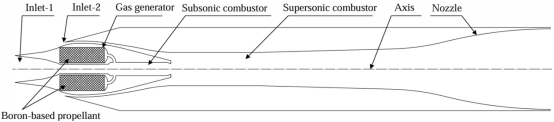
Schematic diagram of the triple-combustion ramjet (TCR) configuration
By means of numerical simulations, this study systematically examined how different inlet air split ratios affect the performance of the triple-combustion ramjet. The results show that the split ratio significantly influences the burnout of boron particles and overall engine performance by altering the oxygen supply to the two combustors and the gas-particle mixing state.
Under the current configuration and at a Mach 7 operating condition, a supersonic-to-subsonic inlet air split ratio of 1:2 proved to be the optimal choice among the schemes investigated, achieving an overall combustion efficiency of 97.1% and a specific impulse of 605.3 s. The study provides quantitative support and a theoretical reference for the design of inlet air distribution and for combustor optimization in the triple-combustion ramjet.
This work was supported by the Key Support Program of the National Natural Science Foundation of China (No. U21B2086) and a project funded by the Taizhou Municipal Science and Technology Bureau (No. 2002 gy07).
Article link: https://doi.org/10.1016/j.ast.2026.113363