Recently, the research group led by Professor Zhu Qiang of TU published a research paper online in *Nature Communications* titled “Enantioselective palladium-catalyzed carbonylation of gem-dibromoalkenes to chiral benzo[7]annulenes”. The study developed a divergent asymmetric carbonylation reaction of gem-dibromoalkenes under palladium catalysis, achieving for the first time the catalytic asymmetric desymmetrization of prochiral gem-dibromoalkenes, providing a new strategy for the modular synthesis of inherently chiral medium-ring molecules.
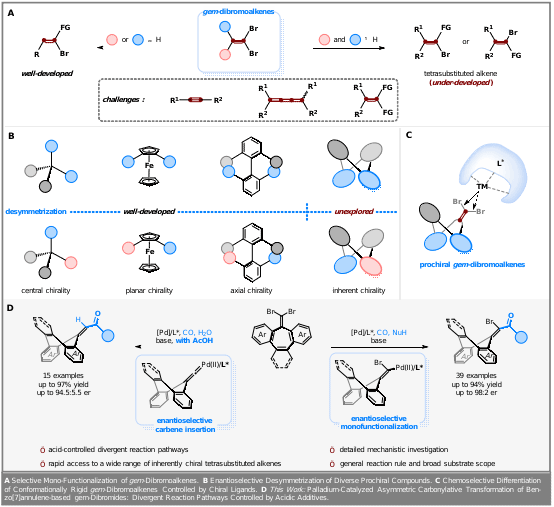
Inherently chiral medium-ring molecules hold unique advantages in molecular recognition, asymmetric catalysis, and functional materials, yet enantioselective methods for their synthesis remain underexplored. Professor Zhu Qiang’s team has long been dedicated to the asymmetric synthesis and application of inherently chiral molecules, particularly inherently chiral medium-ring frameworks, and has produced a series of pioneering achievements (CCS Chem., 2022, 4, 2897-2905; CCS Chem., 2023, 5, 982-993; Chem. Catal., 2024, 5, 100904; Chin. J. Chem., 2026, 44, 771-776; ACS Catal., 2026, 16, 1944-1950; Angew. Chem. Int. Ed., 2026, 65, e671276; Org. Chem. Front., 2026, 13, 6215-6223).
Building on this prior work, the team used conformationally rigid benzo[7]annulenylidene-based gem-dibromoalkenes as substrates and, through tuning with a chiral bisphosphine ligand, successfully achieved high chemoselectivity and high enantioselectivity in the monocarbonylation reaction, with yields up to 97% and enantioselectivity up to 98:2 er. Notably, the reaction could be precisely switched to a double-debrominative carbonylation pathway by adding a simple acid additive, efficiently constructing inherently chiral trisubstituted vinyl carboxylic acid products and demonstrating outstanding pathway-divergence control. The work also carried out systematic mechanistic studies. Combining control experiments with DFT calculations, it revealed that the acid-induced formation of a key alkylidene carbene-Pd-H species lies at the core of the pathway switch, and it elucidated the enantioselectivity-determining mechanism of carbene insertion and CO migratory insertion. Moreover, the resulting chiral products can be further converted into various tetrasubstituted alkenes and potential chiral ligands, and preliminary catalytic evaluation showed promising application prospects (Nat. Commun., 2026, DOI: 10.1038/s41467-026-78226-0).
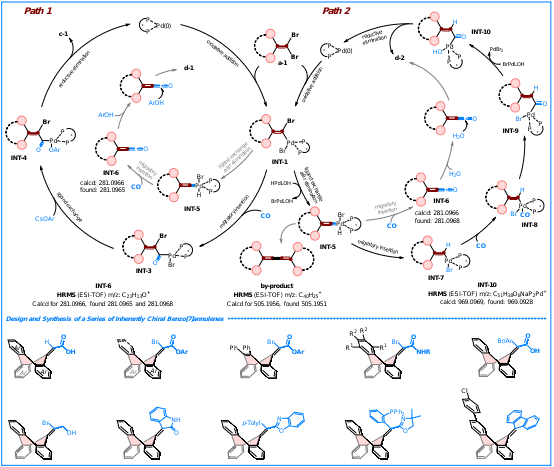
The first author of the paper is Dr. Luo Yu, and the corresponding authors are Professor Zhu Qiang and Researcher Luo Shuang of the Guangzhou Institutes of Biomedicine and Health, Chinese Academy of Sciences (the theoretical calculations were completed by Researcher Luo Shuang). This work was supported by the National Key Research and Development Program of China, the National Natural Science Foundation of China, the Natural Science Foundation of Zhejiang Province, and the Guangdong Basic and Applied Basic Research Foundation.
This achievement not only broadens the scope of palladium-catalyzed asymmetric carbonylation reactions, but also provides an important reference for the catalytic asymmetric synthesis of inherently chiral medium-ring molecules, further enhancing the university’s academic influence in the fields of asymmetric catalysis and chiral synthesis.
Article link: https://www.nature.com/articles/s41467-026-78226-0